William Flashnick
Four Point Five - Thirty Five
Digital Illustrations
[Note: Artist statement at end]
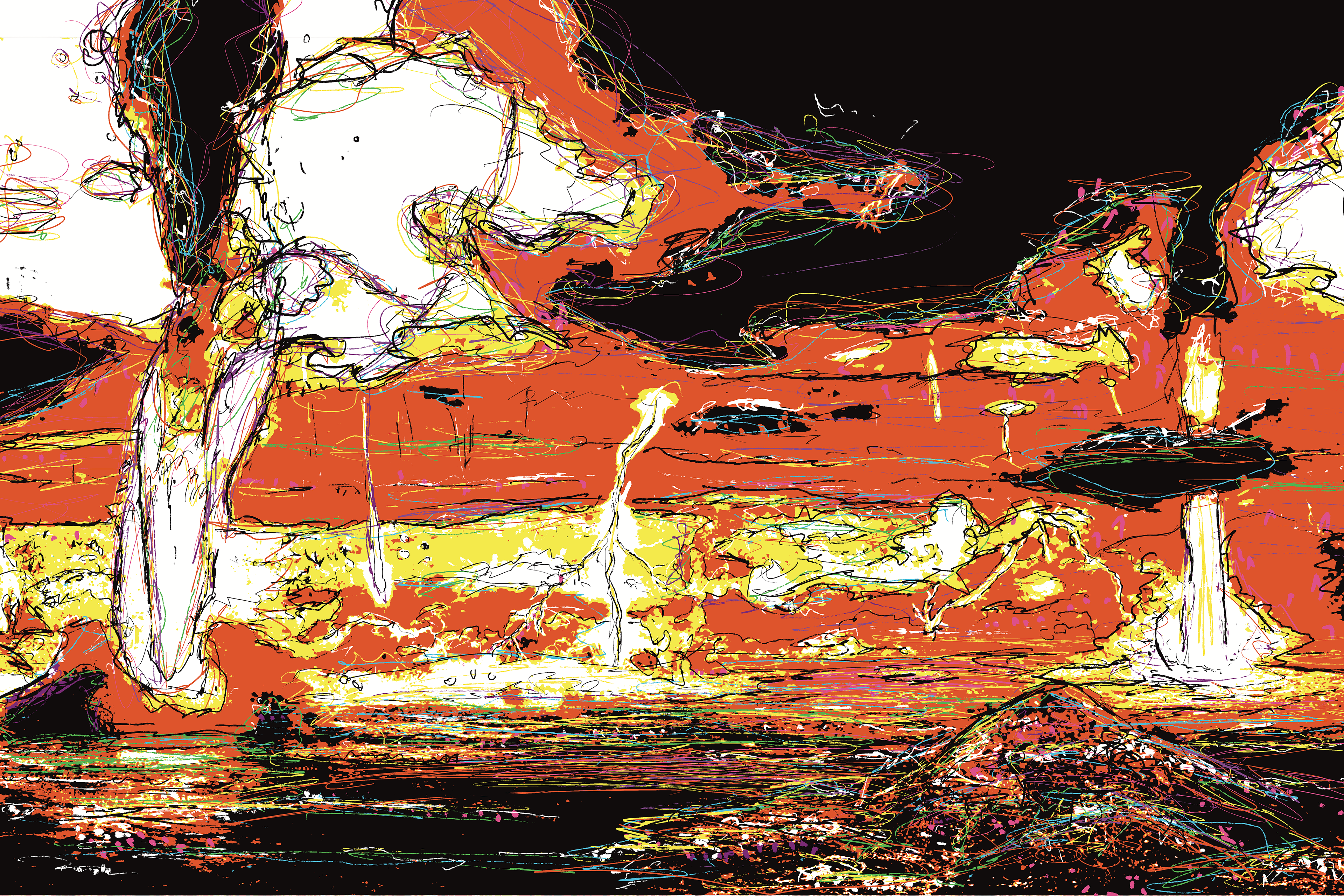
Chaotian - 4,500,000,000 years ago
Before Time there was Chaos
4,500,000,000 years ago, during the Chaotian
The Titan of Sight gazed on our world
Theia the embodiment of Aether
A mars sized proto-planet
Crashed into Gaia, the Earth
And in the intersections of Chaos
3 Children were born to two different generations
Nyx , the night
And Erebus , the darkness.
But the third, this child was touched by gravity
As Gaia healed from the collision
She saw a growing mass of rock above her
The pieces of both herself and Theia
Gravitationally giving birth
To a child that spent her youth
As a companion to the children of Chaos
But she, she was
Sister to the Helios, the sun
Sister to Eos, the dawn
Daughter of Theia
Granddaughter of Gaia
She was Selene,
The beautiful moon,
Born from ashes of two generations before her
ENTER CHAOTIAN - THE LAND BEFORE TIME
The creation of the moon was one forged in chaos. At the start of Earth’s history a rock named Theia about the size of Mars crashed into the young Earth. Earth survived this collision but Theia did not. The debris of the displaced earth alongside the remnants of Theia was bound by gravity in the sky above over the course of millions of years to create what we now call, the moon. A Time defined by chaos, our records of this time don’t exist on samples here on Earth. Right above us, they exist on the moon. Moon rocks and Earth rocks are chemically very similar. Some say they were exact, but others say they can’t be the same because of the collision with Theia. After decades of hypothetical discussion regarding the validity of this, geologists made a breakthrough in 2014 confirming the Theia impact. Using moon rocks collected in Apollo 12, 13, and 16 missions geologists were able to discern between oxygen ratios in chemical analysis of the rocks and determined that a foreign isotope was detected within the rocks. Since every planet in the solar system has a unique isotopic fingerprint, this slight difference proved the moon wasn’t just a piece of Earth that broke off, it contained material from a foreign body, Theia.
-
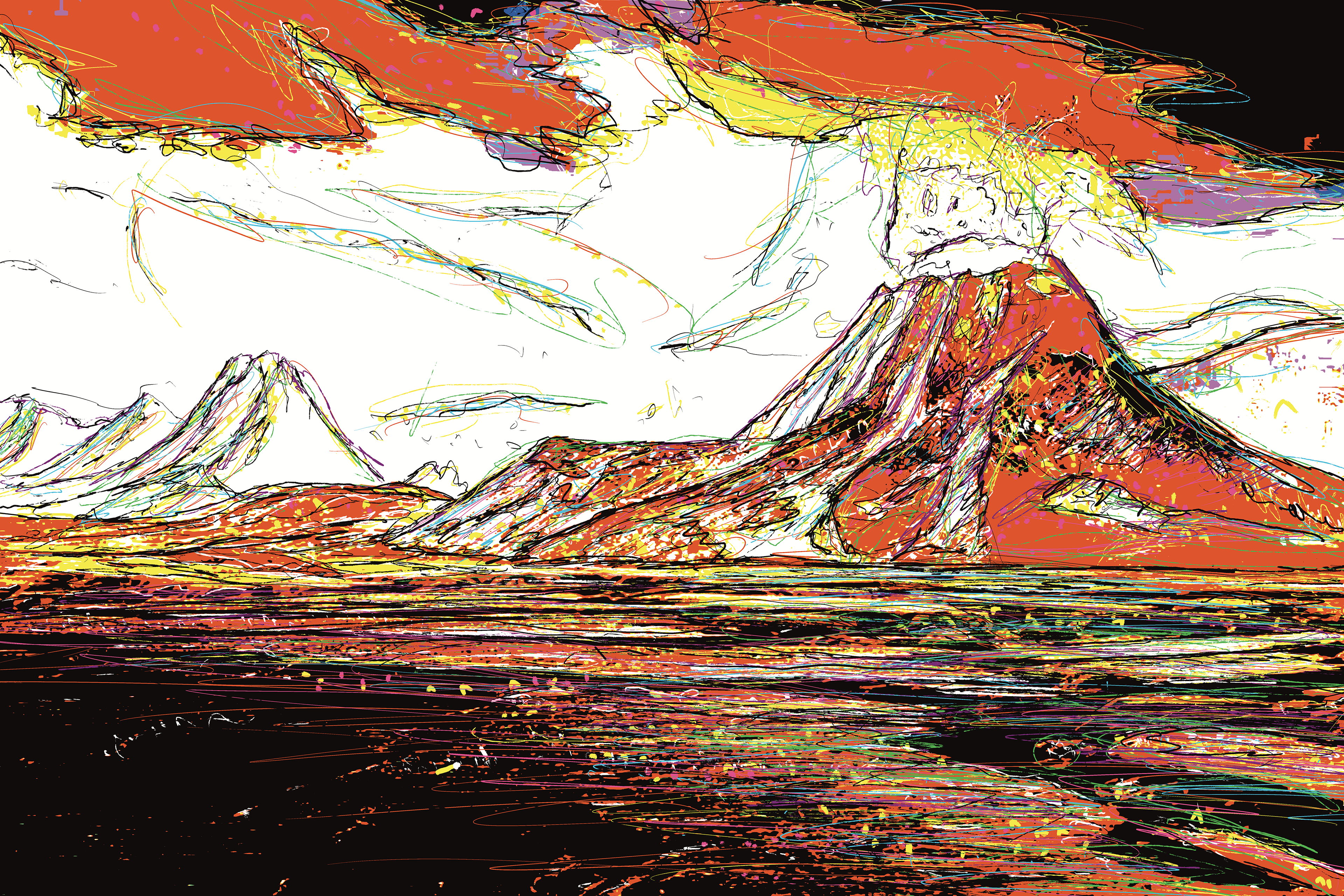
Hadean - 4,400,000,000 years ago.
She was a ball of iron in disguise
Graceless in the universe
Forged from vermillion she rose
In the despair of the burning deep,
The Iron King sinks to the center,
Her heart ablaze hotter than a star
A red-world cauldron,
The weight of the overhead,
The crushing press of a thick,
Sulfurous,
Dream
Where Fire storms pass
And dance with the rain
Vertical seas of lead
Before the first leaf
And before the first breath
The stones were liquid
And screaming
ENTER HADEAN - HELL IS HERE ON EARTH ACTUALLY
Following the Chaos the young world saw generations pass. Hell was brought onto Earth. For 700 million years. Known as the Hadean, this was a period of time at the beginning of Earth’s history characterized by hellish atmospheric and surface conditions due to intense volcanic and geological activity. This was clearly not a place anything wanted because it would literally be billions of years before any life. The data from this time is very little but it does exist and the vast ranges in the dates are also due to this. During this time Earth and Moon were consistently hit by meteors and created a magma sea and fiery, hellish planet. It’s named as the Hadean period of time by geologists that were inspired by Greek mythology of the god of hell, Hades. (Hadean)Similar with the predecessor, the titan of the abyss, Chaos (Chaotian) The names are used Geologists to define different period of time in an intense scientific timeline known as the GEOLOGICAL TIME SCALE (GTS)
-
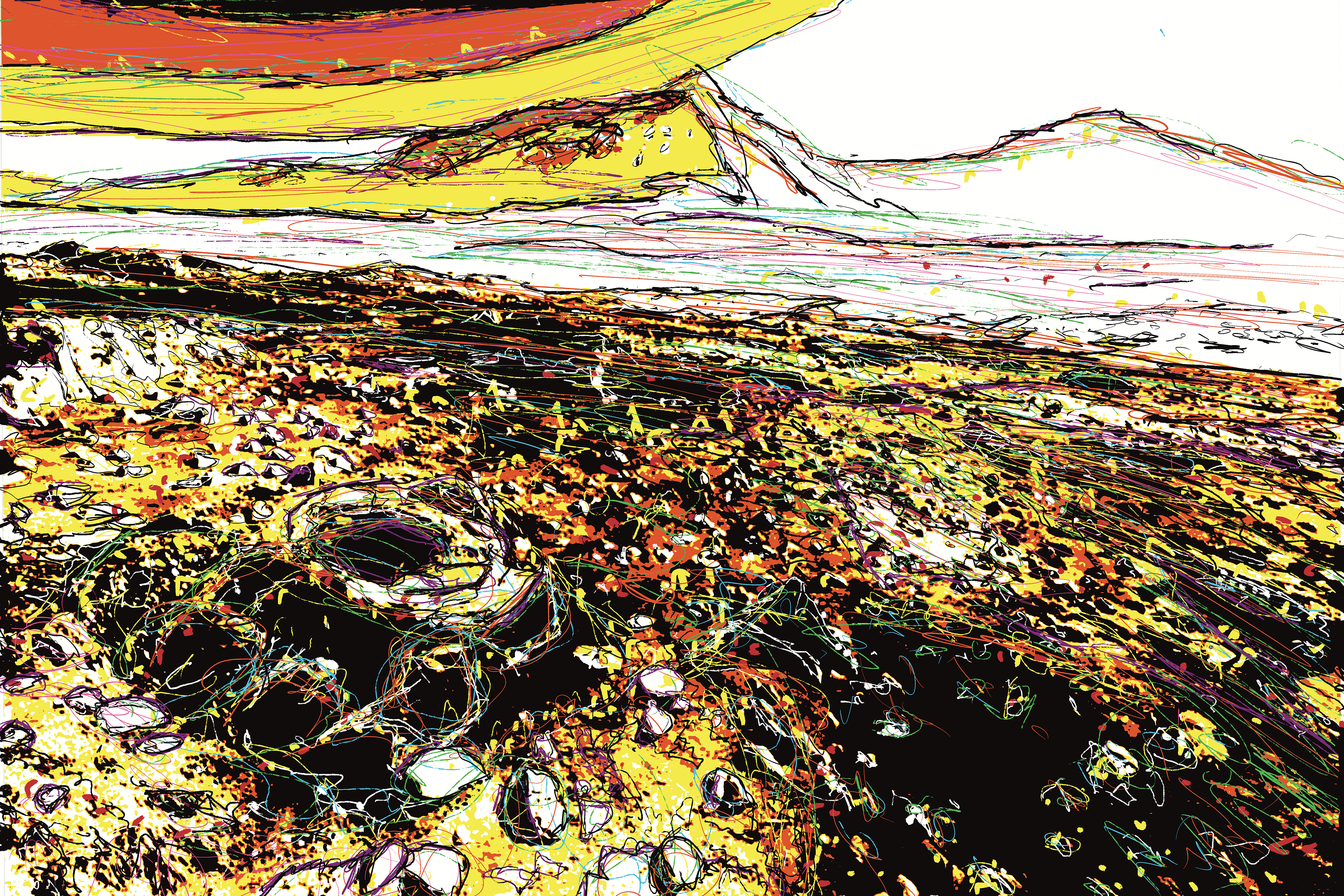
Eoarchean - 4,000,000,000 years ago
I understand the silence above us
Universe is 13.8 billion years old
But we see now its immensity
And in the Earth’s slow turning
4.5 billion years pass
Eukaryotes, 2 billion
And us, only 10,000 in the sun
Have they had their season?
Time enough to simply be?
I believe unquestionably
But to bridge the cosmic void
To be capable of knowing of us
I’d say no
As we understand distance
And the speed of light
Because
For all we cannot know
Something living, on another world
Could have glimpsed at ours
And would have saw hell
Because our brief existence
Is beautiful
And coincidental
ENTER EOARCHEAN - THE GEOLOGICAL TIME SCALE: BEAUTY AND COINCIDENCE
As we go you’ll learn a lot, so first I want to provide you with a brief overview of the GTS, geological time scale! I have organized my project using this scale, so by understanding this it will help the information be a bit more digestable. The earth is divided into 4 Eons. The Hadean, Archean, Proterozoic and Phanerozoic. An eon is the longest division of time here and each of these 4 eons encompass and date all 4.5 billion years of geological data that we have been able to gather. The transition from the Hadean to the Archean was not very drastic, but it was the beginnings of an Earth that’s even remotely recognizable. Like the Hadean, the start of the Eoarchean was a hot, volcanically active time for our anaerobic world. The changes started as early continental crusts formed against a soon to arise global ocean. The atmosphere was thick and toxic, made of methane and ammonia. Earth was completely lifeless, and time crawled by as she floated through the void.
-
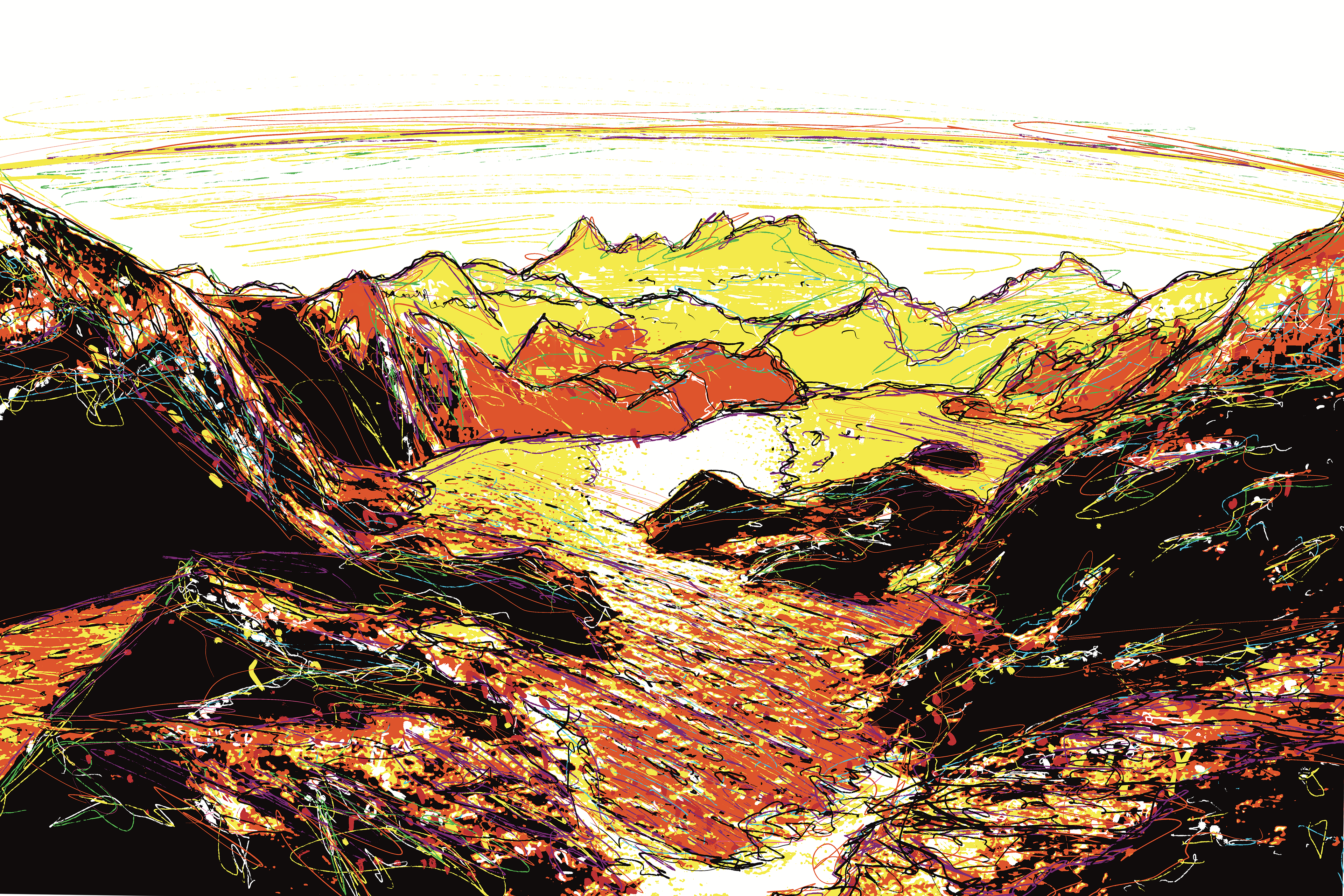
Paleoarchean - 3,600,000,000 years ago
The first forms
Rising from elemental strifes
Iron seas under orange skies
Stromatolites in shallow bays,
Breathing out the coming blue
Turning light to living rays
The world of the Archean
Where the earth’s own fire leaks,
Life stirred in the silence,
In the shadows of mineral peaks.
Beneath a dim and youthful sun.
ENTER PALEOARCHEAN - RISE FROM ELEMENTAL STRIFE
You might be wondering why I have 35 works but have already gone through one of the 4 eons already and you just got here. I will explain. Essentially the farther away from the present you are in this timeline, the bigger the divisions in time will be. This is due to less data, as early earth history is divided much more largely and loosely since we don’t have enough to be able to mark between further distinctions since it was so long ago. As we analyze rocks and their compositions we are able to carbon date them and determine when they were formed and what the earth was like at the time. Our oldest analysis shows us that earth and moon rocks share similar compositions due to the impact with Theia into earth essentially giving birth to the moon. After that we have the oldest earth rock data, which dates back to the hellish time of the Hadean eon. And then it moves onto the next eon, Archean. We have more data by this point so this Eon is divided into 4 ways that encompass this eon's 1.5 billion years of history. This second division, the Paleoarchean, was actually the beginning of life. Deep in that worldwide ocean of what we’d probably consider acid now, the first prokaryotic cells emerged. The single celled organism. The first life.
-
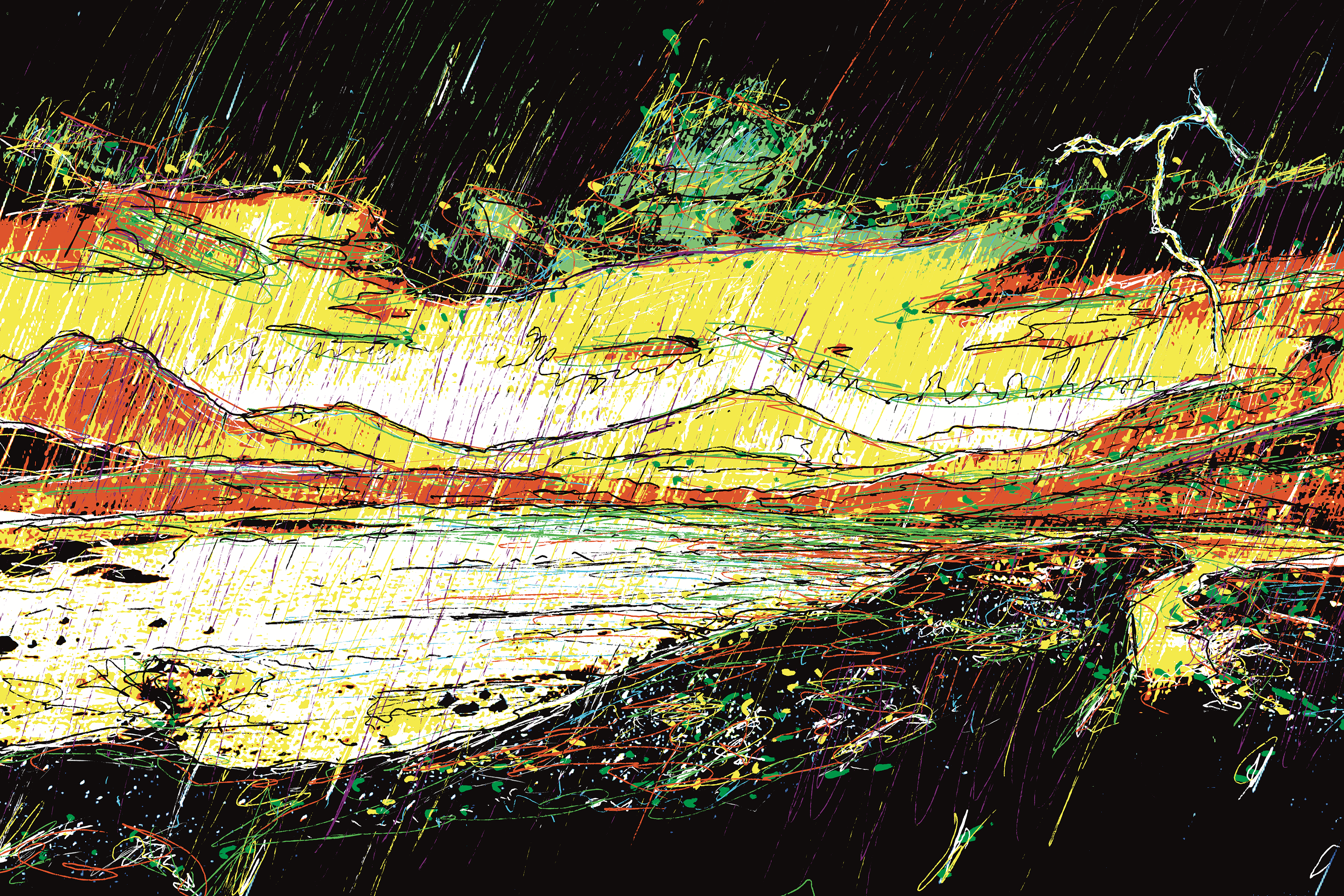
Mesoarchean - 3,200,000,000 years ago
Enter the Archean
The one-celled creatures
Combatants of the sulfuric,
Boiling black sea bottoms
Where they stayed,
And established themselves
In dense salts and acids
Where they survived
By eating metal.
The first nourishing of self.
They were too meager in heart for compassion,
And too small for tears
Not one of their trillions
Has ever been given a tombstone.
But they were more committed than the oblivion,
More prolific than stars.
ENTER MESOARCHEAN - THEY SURVIVED BY EATING METAL
For the Archean I drew on imagery from other exoplanets and their atmosphere as well as our neighbors like Mars and Venus. It seems for about a billion years or so Earth could’ve actually been called the crimson, umber, maybe even the chartreuse planet. The little atmosphere that was there likely was not blue at all in Hue for a long time due to large amounts of harsh gasses like methane and ammonia. It likely faded to orange the next billion or so, and when photosynthesis started at the beginning of the protorezoic, the sky was likely yellow > green for a couple hundred million before we got the blue we do today.
-
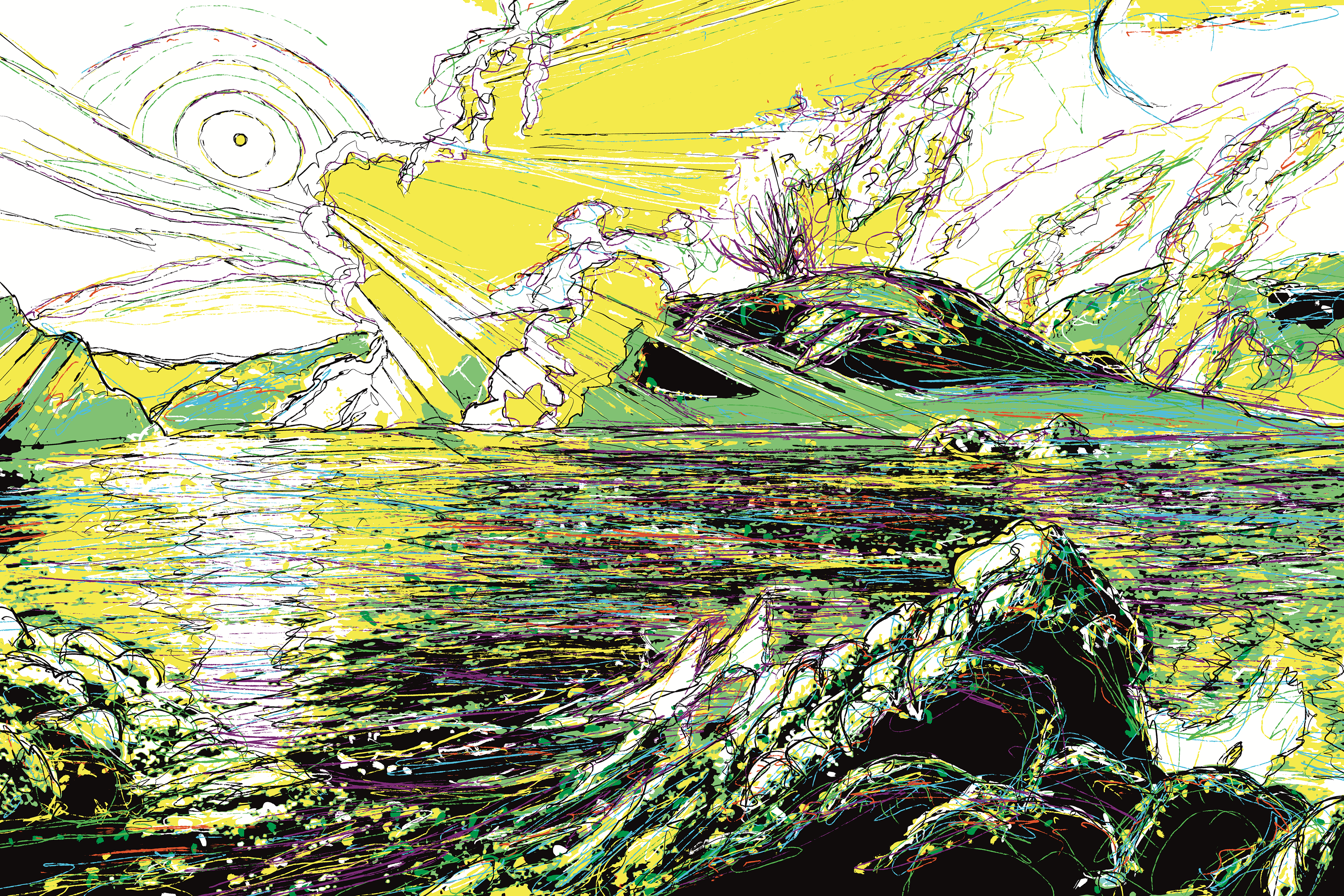
Neoarchean - 2,800,000,000 years ago
The closing of the door,
The end of the
Unbridled youth of stone,
In the sun-washed shallows of the world-sea’s edge,
They build towers.
Weavers of the coming,
Feeding on light
They exhale a promise
That the sky can’t yet hold,
A thin, bright poison to the ancient ways,
Setting the trap for the rusting of the earth
And the birth of the
Blue and transparent days.
Everything that will be is waiting in the salt,
In the microscopic stirrings and the mineral dust.
ENTER NEOARCHEAN - AT THE WORLD-SEA’S EDGE
During the Neo, the Earth's crust finally began to stabilize and form the first large-scale continents. This tectonic shifting paved the way for the rise of oxygen-producing cyanobacteria, which began releasing the first significant puffs of oxygen into the atmosphere through photosynthesis. These microscopic pioneers laid the foundation for future life, while intense volcanic activity fueled the growth of vast mineral deposits that would eventually become the bedrock of our modern world.
-
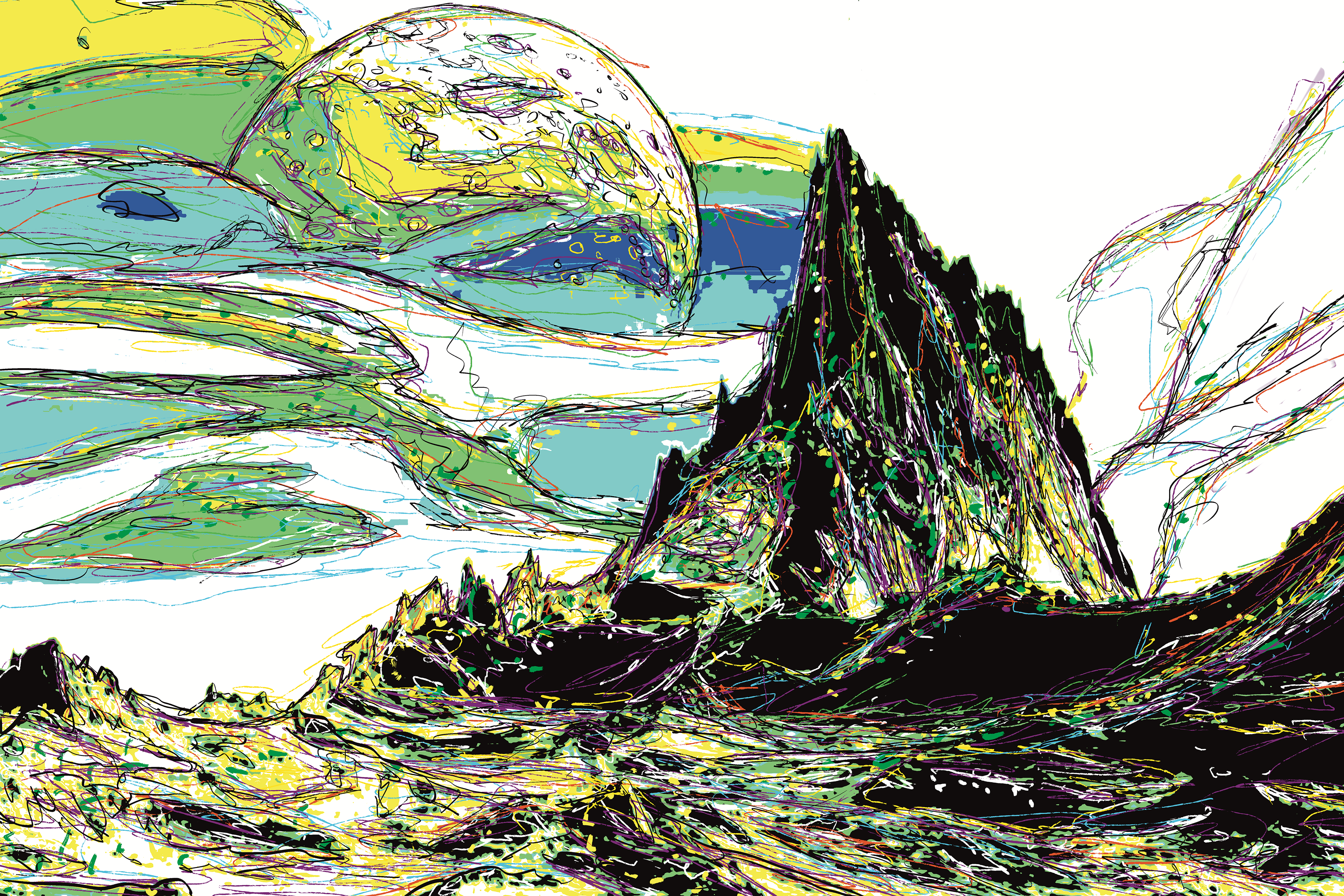
Siderian - 2,500,000,000 years ago
A ceiling of thick, toxic jade,
A heavy fog where the orange light dies.
The methane shroud begins to fray
As the new-born poison rises
A Lime-washed vault,
A sulfurous glow,
Watching the ancient ages pass.
The green is a skin that is peeling away,
A dying color in a chemical war.
The sharp, cold breath of the coming day
It is at the atmosphere's door.
Oxygen bites,
And emerald thins
ENTER SIDERIAN - AWAY FROM MY LAND
The Siderian was an age of planetary-scale oxidation as the waste oxygen from thriving cyanobacteria finally saturated the world's oceans. This massive chemical shift caused dissolved iron to precipitate out of the water, creating the iconic banded iron formations that now provide most of our modern iron ore. As the oceans cleared and oxygen spilled into the atmosphere, it triggered the Oxygen Catastrophe, a global crisis that wiped out countless anaerobic species while simultaneously causing methane levels to plummet and usher in an ice age. Away from my land, in the siderian a billion lifetimes ago.
-
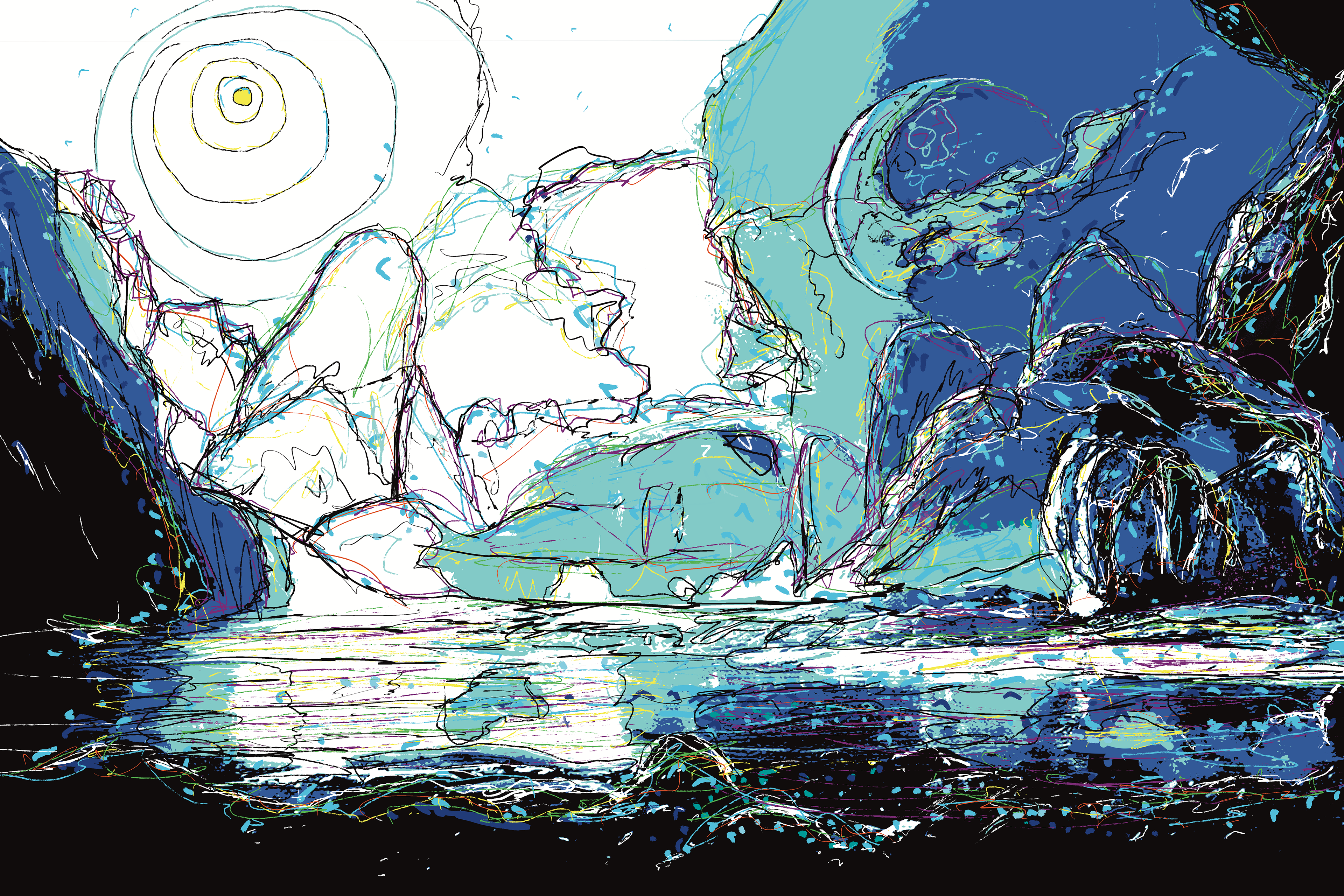
Rhyacian - 2,300,000,000 years ago
The first ice age,
The Rhyacian
Under her regime of ice
Boreas has turned the world into a relic,
A sphere of unmoving crystal
Where the air is sharp and sterile.
And volcanic memories stir
Their breath trapped beneath
The miles of silent white,
The pressure builds its dark insurrection.
Carbon is gathering in the throat of the deep,
Waiting to dissolve the ice
And turn the marble into a sea.
ENTER RHYACIAN - THE SPHERE OF CRYSTAL
An Ice age is any period of time on earth where there are ice caps on both poles. You might not know but today you lived through a day in an ice age. And the day before. And every day actually. We have ice caps so we are in an ice age. They are the North Pole and Antarctica. The earth has only had 7 ice ages. You might be thinking it sure doesn’t feel like an ice age. I’ll explain. The current ice age started about 2.5 million years ago, but right now we are in an interglacial period that started about 12,000 years ago or so. Interglacial periods are brief periods of warming during ice ages that last about 10-30,000 years. On the scale of it 30k isn’t much, especially since we’re 2 million years into an ice age already. And especially when we consider ice ages last on average maybe 150-200 million years. What is 30k? What happened deep in the rhyacian? What do we have to learn?
-
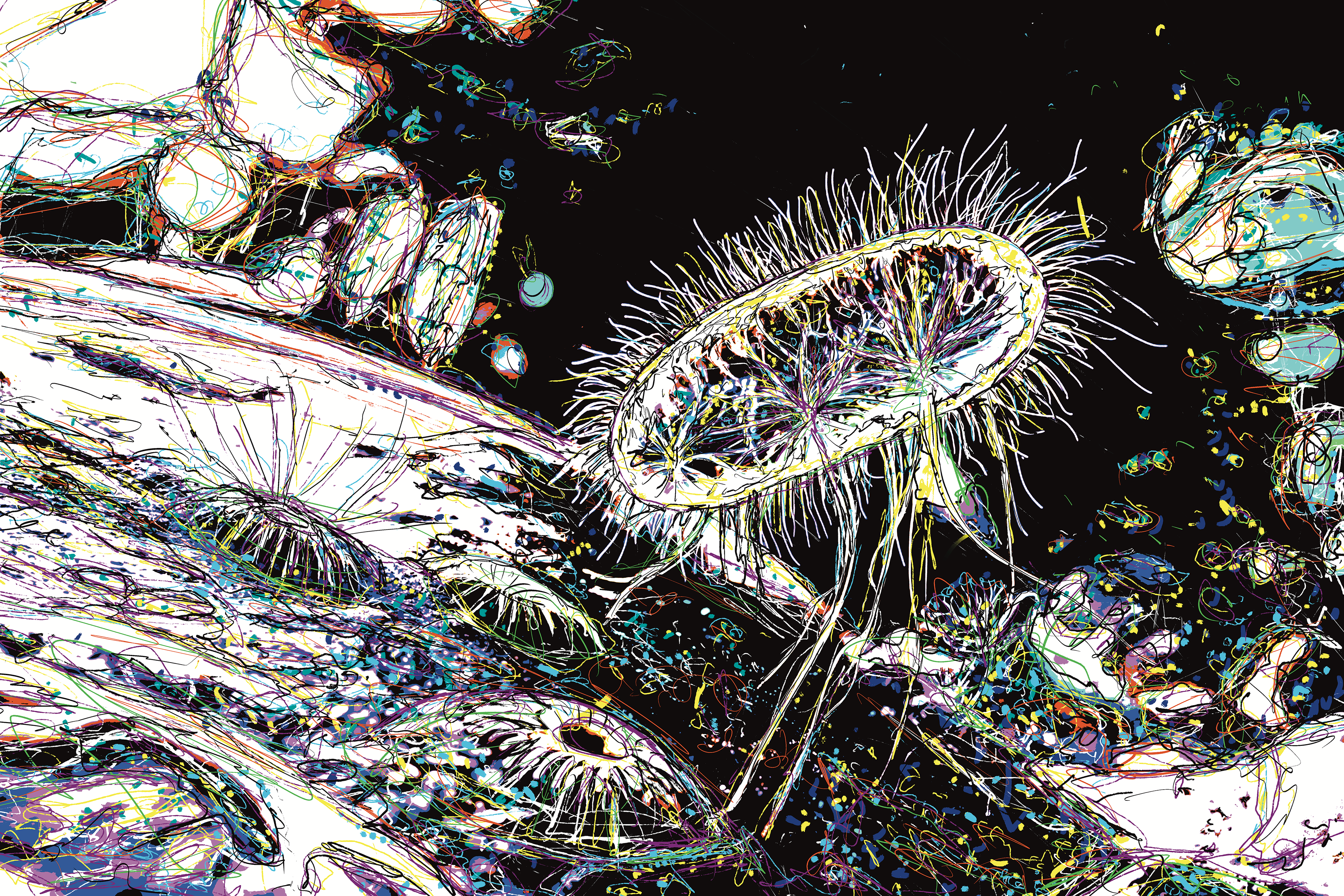
Orosirian - 2,050,000,000 years ago
I saw the lithosphere’s violent upheaval,
Where the chains of the previous era dissolved,
A thermal surge
Born of carbon from the deep.
I experienced the celestial kinetic strike
A bolide of velocity,
Piercing the mantle
I felt the metamorphism
Ripple through the strata
Vaporizing stone and reordering the quartz,
Pain etched into her skin.
I am there as the mountains ascend,
Buoyed by a thickening root,
While the saturated atmosphere
Accelerates weathering
Ushering an age of intense mineralization.
The first true structural architecture
Of a world hardening,
Into her enduring form.
ENTER OROSIRIAN - REMEMBERING THE VICTIMS OF COSMIC VIOLENCE
The Orosirian was a period of construction and cosmic violence as the Earth's scattered landmasses began to assemble into one of its first giant supercontinents, Columbia. This era earned its name, meaning "mountain range" from the massive tectonic collisions that thrust up jagged peaks on nearly every continent. While these ranges rose, the Earth was rocked by two of the largest asteroid impacts in history: the Vredefort strike in South Africa and the Sudbury event in Canada. These colossal impacts sent shockwaves through the crust and enriched the soil with massive mineral deposits. This is all while a now oxygen-rich atmosphere supported the quiet evolution of life's newest and most complex cellular structures.
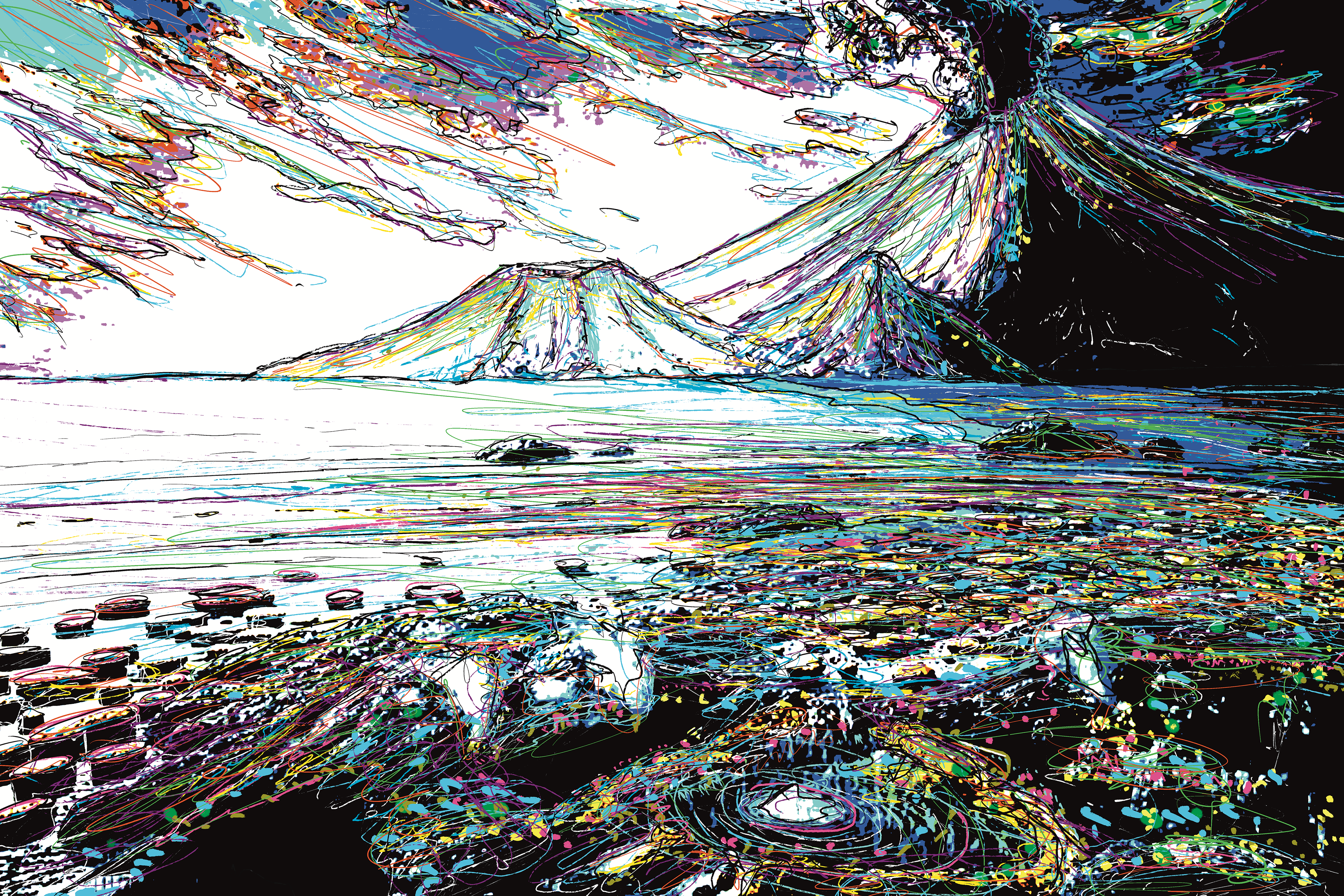
Statherian - 1,800,000,000 years ago
I view life and death differently now
For better and worse
It'll happen
That means there's so much to do before then
And it's gonna be so great
Because getting to be alive is the greatest privilege
Because earth only lets us do it once
I think
Though we are small against the cosmic tide,
With thoughts as deep as space is dark and wide
We feel the pulse that moves the furthest star,
And dream of worlds beyond the ones that are.
It’s so great to be human
An animal
With higher capacity for feeling
Not driven by the hunger or the vein,
But by the heart, the wonder, and the pain.
It’s beautiful
In the scale of it all
Just about everything that has ever lived has died
To touch the leaf and sail the ancient sea.
Though every life must sink beneath the rust
And every king must return unto dust
We are different
But in final sense
Just the same
Great is the privilege to simply be
ENTER STATHERIAN - THE BORING BILLION
Marking the start of an Era known as the boring billion, this was an era of geological calm as the Earth’s crust finally reached a state of "firm" stability. This period saw the assembly of nearly all the world's landmasses into the colossal supercontinent Columbia, creating vast, stable platforms that stretched across the globe. In the oceans, life experienced a quiet but revolutionary shift; the first complex eukaryotic cells began to diversify, marking the transition from a world of simple bacteria to one teeming with organisms possessing distinct nuclei. While the surface remained relatively peaceful, bizarre phenomena occurred deep in the crust, such as the natural nuclear fission reactors at Oklo, which generated power through self-sustaining chain reactions for thousands of years. If I were to write a headline about what went on back then we wouldn't have much. BREAKING NEWS! Bacteria in a puddle found slowly eating the same rock FOR A BILLION YEARS.
-
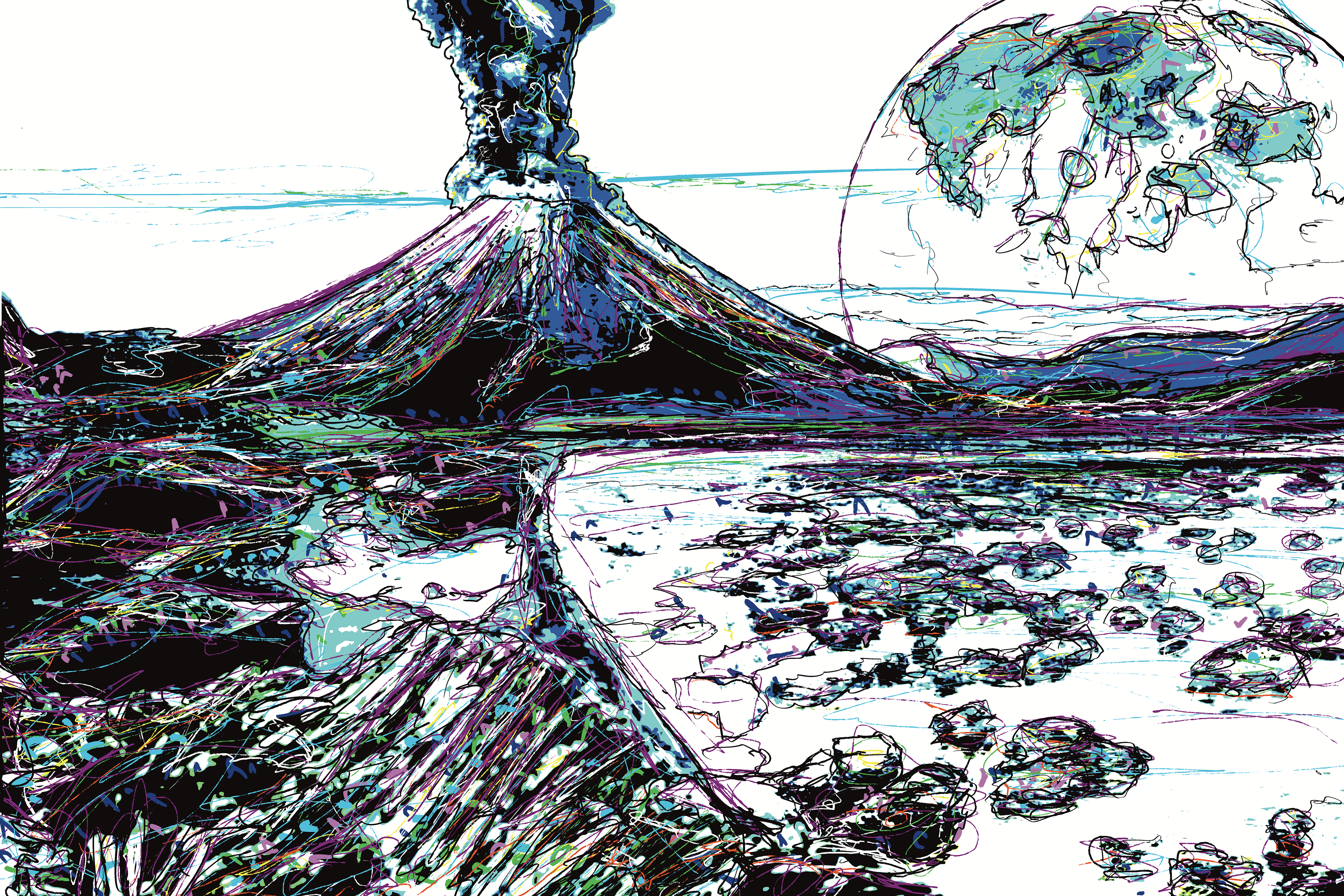
Calymmian - 1,600,000,000 years ago
The sequences of silt and carbonate accumulate,
The architectural steadying of the cratonic blocks
They stretch thin across the cooling depth.
Can you feel the intrusive surge
Of anorogenic magma,
Granite pulses that thicken the stable shields
Without the violence of a mountain’s birth.
In the quiet, oxygen-poor reaches of the shelf
Beginning to dominate the widening submergence
Of a world defined by its expanding liquid margins.
ENTER CALYMMIAN- THE CALM
The Calymmian was a period of both literal and metaphorical "covering" as the Earth's crust continued to thicken and stabilize across its ancient cratons. While the land grew thicker, the once-stable supercontinent Columbia finally began to rift apart, cracking into massive fragments that would drift independently for hundreds of millions of years.
-
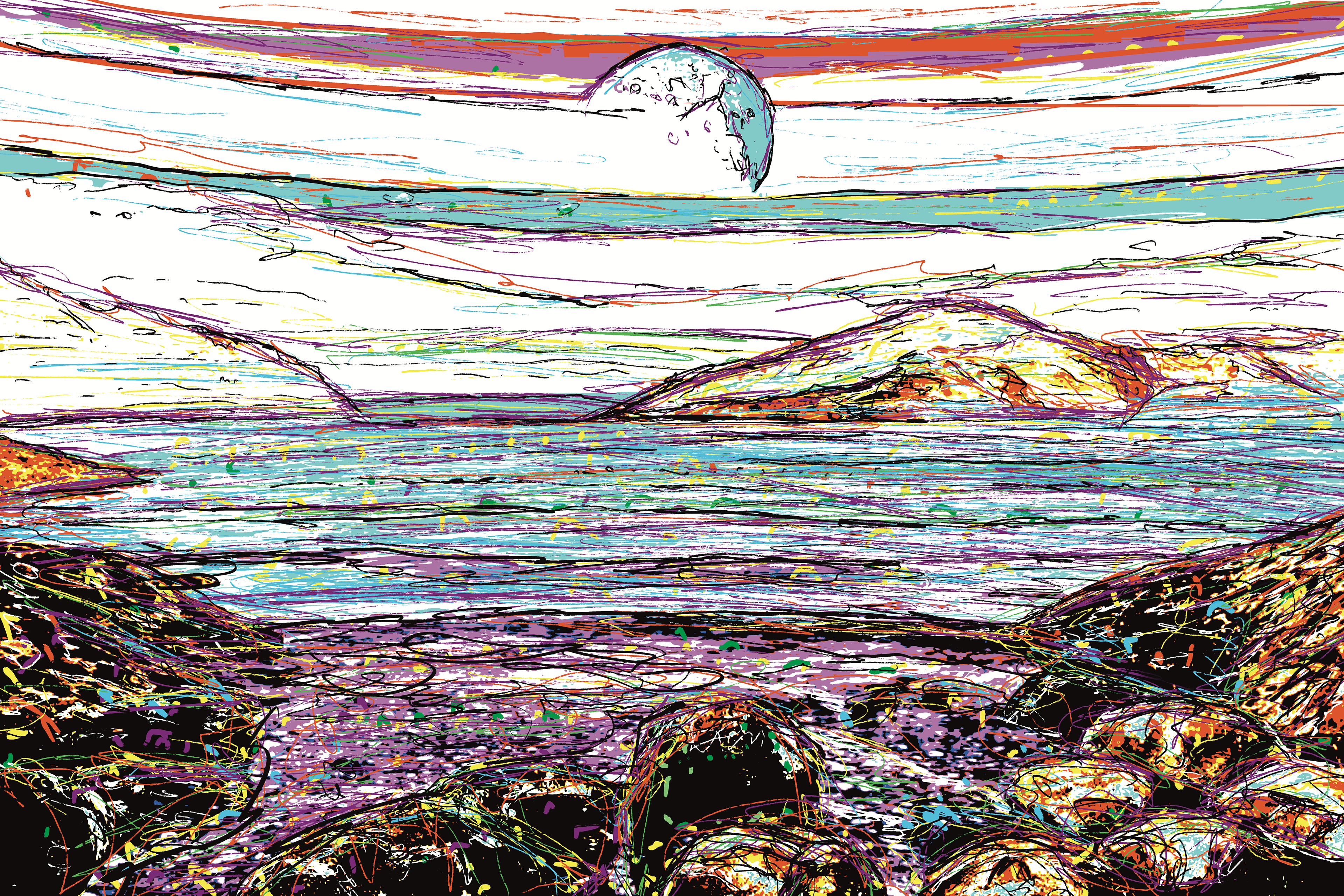
Ecstasian - 1,400,000,000 years ago
The continental platforms extend
In a long and lateral reach,
Stretching into the widening grasp of the sea.
Endless sedimentary rain falls through the brine,
Rhythmic accumulation of carbonate and shale
Blanketingsunken shoulders of the world.
A molecular shift occurs
The transition from simple division
To the complex dance
Of genetic recombination.
The first filaments of red algae take hold,
Their cellular architecture locking in a blueprint
For everything that ever will follow
Life crosses a threshold, moving beyond mere persistence
To innovate within the vast silence of the shelf.
ENTER ECSTASIAN - PARTICLES ARE HAVING SEX
The Ectasian was basically a long stretch of geological stability that actually hid some of the most important changes in Earth’s history. For about 200 million years, the continental shelves just kept growing and collecting thick layers of sediment. But the big deal was biological—this is the first time we see definitive evidence of eukaryotes using sexual reproduction. It’s when things like red algae started showing up, proving that life had finally figured out how to shuffle its genes and create real variety.
-
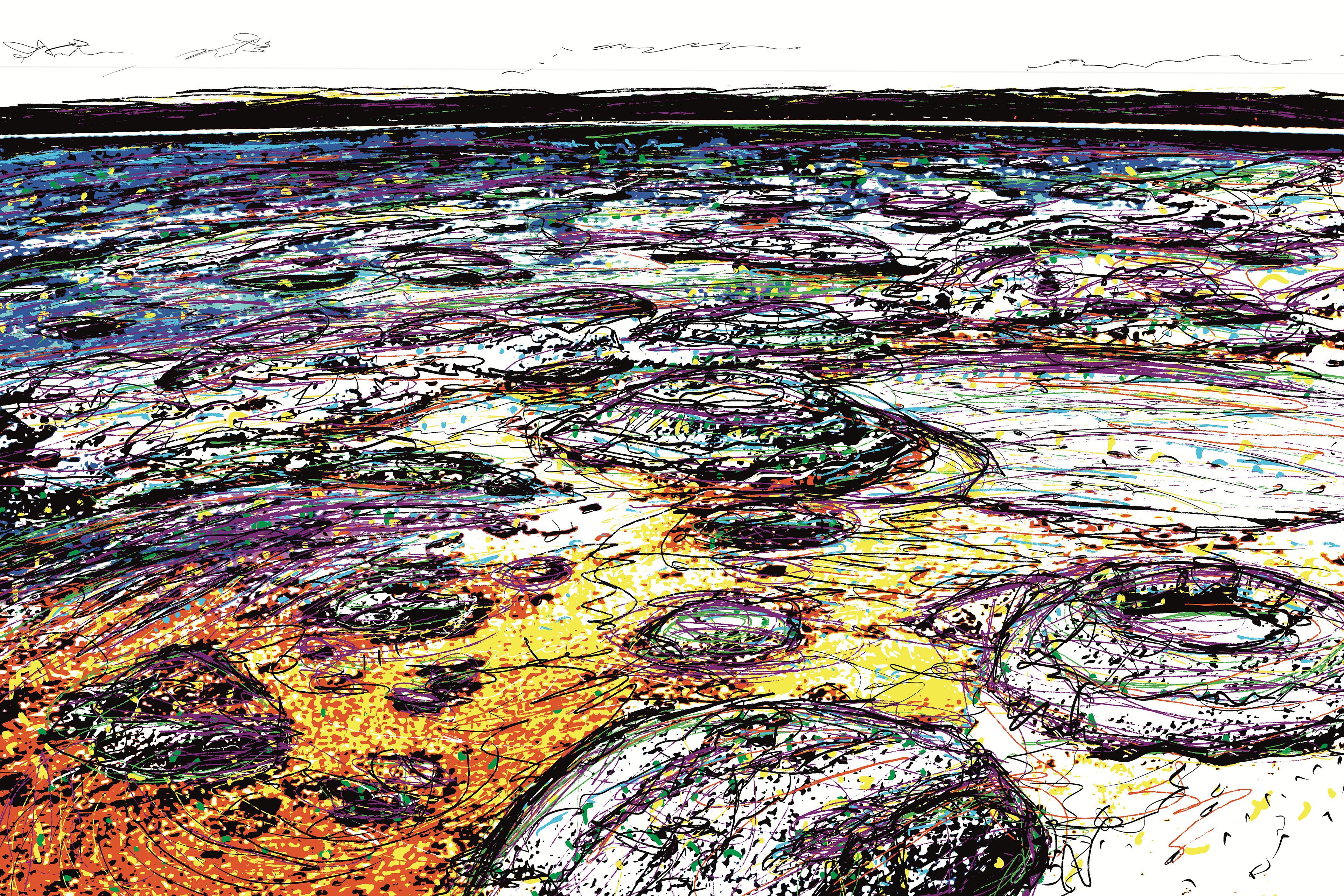
Stenian - 1,200,000,000 years ago
Billions of years ago
Deep in the churning oceans, solitary drifters
Begin to cluster into integrated colonies,
Testing the limits of structure and bone.
The limits of experience
If we didn't have ears,
Humans wouldn't know sound existed,
Meaning there is a possibility
Things could happen perpetually
At all times, all history
We just don't have a body part to decipher it
We can’t detect magnetism,
Decipher radio waves,
Or see outside our color spectrum.
The world of infrared,
Ultraviolet,
Radiations,
Neutrinos,
And a million other things
We know exist
Without having any way
To detect them with our senses.
Our perceptions are not the standard experience of living
They are quite rare
ENTER STENIAN - FOSSIL RECORD INTO MY WIRING: I AM THE PERFECT MACHINE
The Stenian was an era where the Earth’s landmasses finally finished smashing together to form the supercontinent Rodinia. This created the Grenville Orogeny. This was a massive mountain-building event that left a mark on almost every continent we see today. On the biological side, life was getting more complex, with some of the first multicellular organisms starting to appear in the fossil record. It was the end of a long period of stability and the start of a much more active, tectonic-heavy world.
-
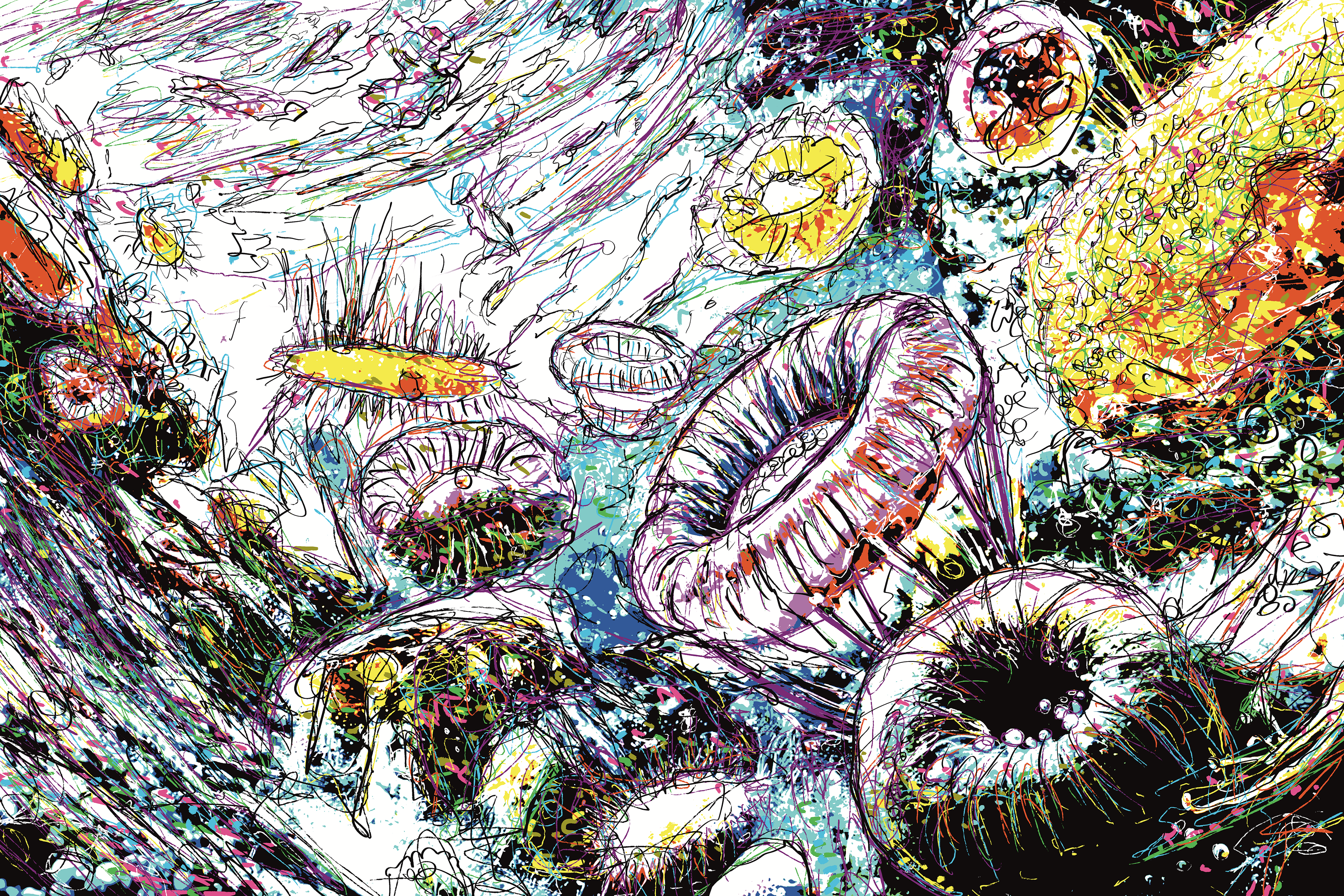
Tonian - 1,000,000,000 years ago
Maybe in the boundary where Rodinia began to pull apart,
There’s something to learn
religion, spirituality and science
It brings me forward in thought;
A stone heart tearing at the seams.
A holy severance across the crust,
Where the rifts fill with the first deep floods
Historically, humans have always been in tune
Apothecaries, healers, priests,
Doctors, witches, monks, and shamans
Our senses want to understand what we can’t.
Subconsciously, we detect these microscopic changes,
But I do not understand why.
We know there is something more,
That we don’t understand,
The moment life begins to dream of moving on its own.
Maybe when the world was a sanctuary
Of oxygen and salt,
Within the sun-shot waters, a new breath
The acritarchs blooming
Even now
I’ve noticed many of the greatest scientists
And minds in history,
Had something to pray to.
ENTER TONIAN - ICON IN THE BRINE : HE WILL MISS THE POINT
The Tonian was all about the breakup of the supercontinent Rodinia. After millions of years of being stuck together, the land started to rift and pull apart, which opened up new oceans. This was also a huge moment for life. We see a big boom in complex plankton, and some scientists think this is when the very first animals, like primitive sponges, started to evolve. Geologists perceive this time kind of as the setup for the massive changes and deep freezes that were coming next.
-
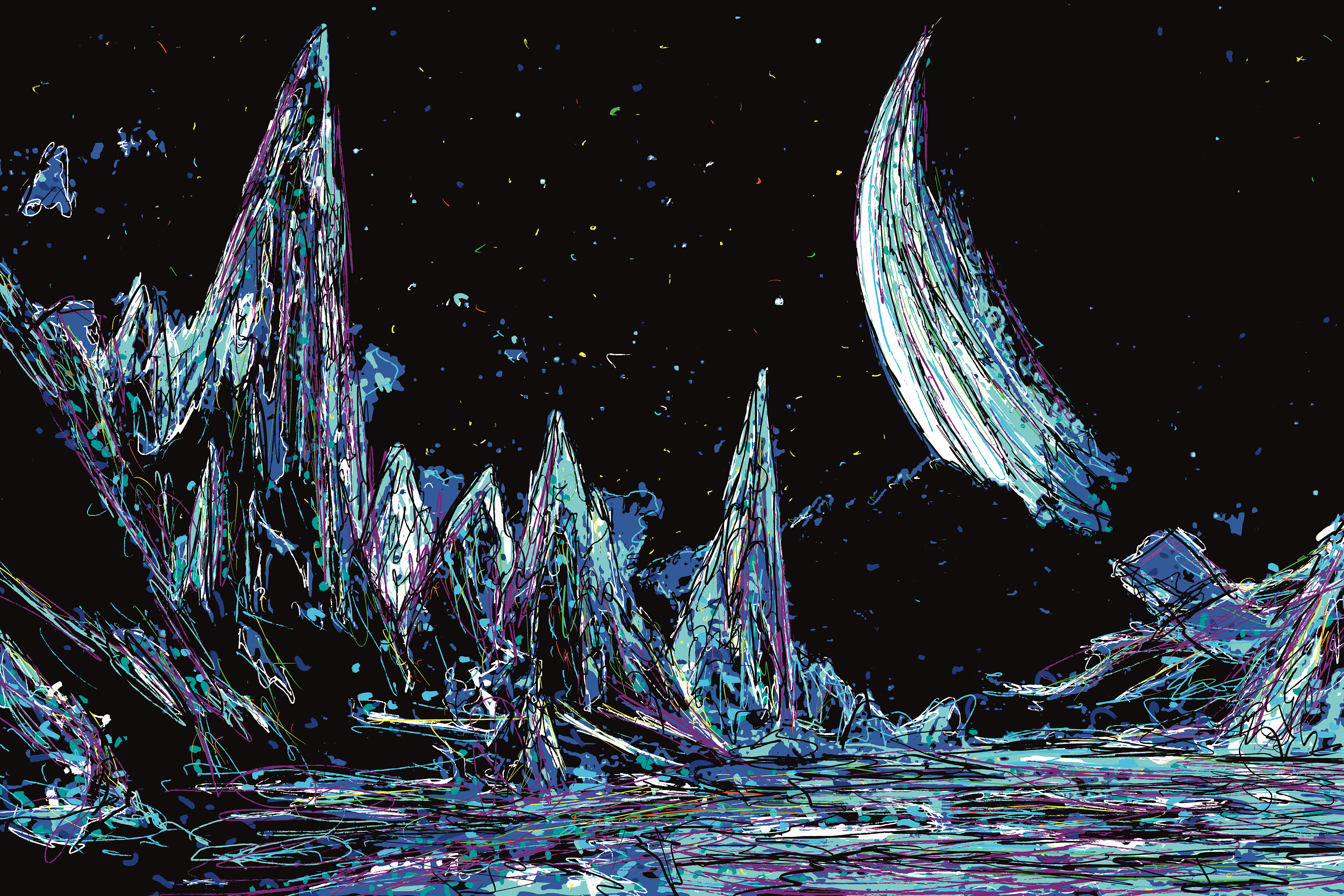
Cyrogenian - 720,000,000 years ago
How lucky we are to be here, once willing
To dream beyond a frozen world,
The ice descends like a shroud,
A baptism that freezes the world
From the poles to the heart of the equator,
The tides are stilled in a temple of crystal,
And the sun is a distant unfeeling light
Shining onward any way
Beneath the weight of the frozen cathedral,
The earth, in lonely vigil.
Life is a remnant, shivering prayer
Huddled in the steam of the deep-sea vents,
Waiting for the stone of the winter to roll away,
Waiting for the fire
The sky held its breath for millions of years.
ENTER CYROGENIAN - THE SNOWBALL EARTH
The Cryogenian was essentially the ultimate deep freeze. We call it "Snowball Earth" because the glaciers actually reached all the way to the equator, turning the whole planet into a giant ice cube for millions of years. It was a brutal time for life, which got pushed into tiny refuges like volcanic vents or spots where the ice was thin. Surprisingly, this extreme pressure might have been what forced life to finally evolve into more complex, multicellular forms just to survive. As you know we are also beings of a current ice age, thriving during a period of time called an interglacial period, something that lasts about 10-30,000 years where glaciers retreat and the equator is warm. I wonder what will happen to humanity. When is the end of the interglacial period? I can’t find much about it even from past ones. The best reason I got to why interglacials end and we go back to glacial periods is due to orbital things like planet alignment and stuff and that’s on such a slow scale and hard to track. The only reason the ice sheets retreated 12,000 years ago was because the planet tilted just a little bit closer to the sun in the north and that allowed the ice to melt just enough for us to thrive. I feel like our window has been really short as humans. If you think about it at the rate things go, the future of humanity is bleak to me. Say we get lucky and the interglacial lasts another 20,000 years. At this rate there is literally no way we don’t prematurely end the ice age in the next 2000 years by accidently melting Antarctica or something. It holds 90% of the world’s ice. Say all of it melted literally at once somehow, every coast line in the world would see a 200 foot tall tsunami. There’s no way that would happen though because even just 10% could wipe out humanity. I fear for the humans of the future. I hope that they are able to live in harmony with the climate , and to not continue to change it the way people of our age have.
-
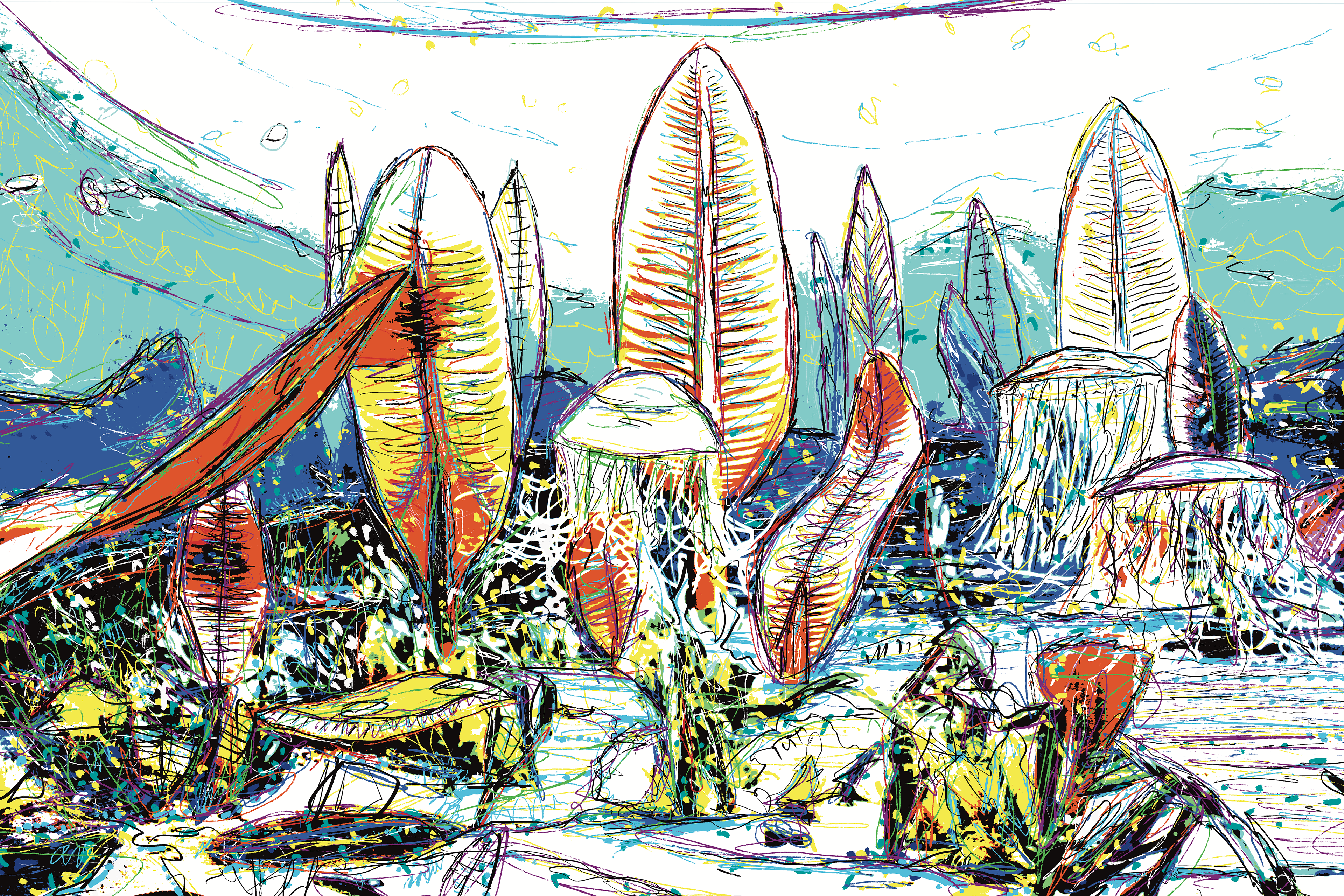
Ediacran - 635,000,000 years ago
,
Born in a flooded world
The fronds of Charnia rise
Rooted in the silt of a brand-new peace,
Swaying in the tides of a quiet garden
Where no mouth has yet learned to bite.
Strange forms drift through the blue,
Spirits of the Cambrian's eve.
In a world that knows nothing of bone or of eyes.
This is the dawn of the garden of the strange,
Where life is a sketch in blue India ink.
The architecture of the animal is tested here,
Before the hardening,
Before the first hunt,
I am thankful for the velvet light of the Ediacaran dawn.
ENTER EDIACRAN - SUNLIT SHALLOWS SPEAK TO ME IN THE MORNING
We are nearing the end of Earths history. To some here is where it just begins. This was a surreal time right before the famous Cambrian Explosion. The planet finally warmed up after the big freezes, and life went wild with strange, soft-bodied organisms that don't look like anything alive today. You had leaf-like things like Charnia anchored to the sea floor and flat, quilted discs like Dickinsonia crawling around. It was a peaceful world without predators or hard shells. Often called the "Garden of Ediacara" , this was used as the final testing ground before complex animals took over. During the Ediacran, the Earth turned 4 billion years old. In the scale of it all Earth is only 4,5 billion years old. So much history had already passed before even the first true plants came to be. Our existence is brief and beautiful.
-
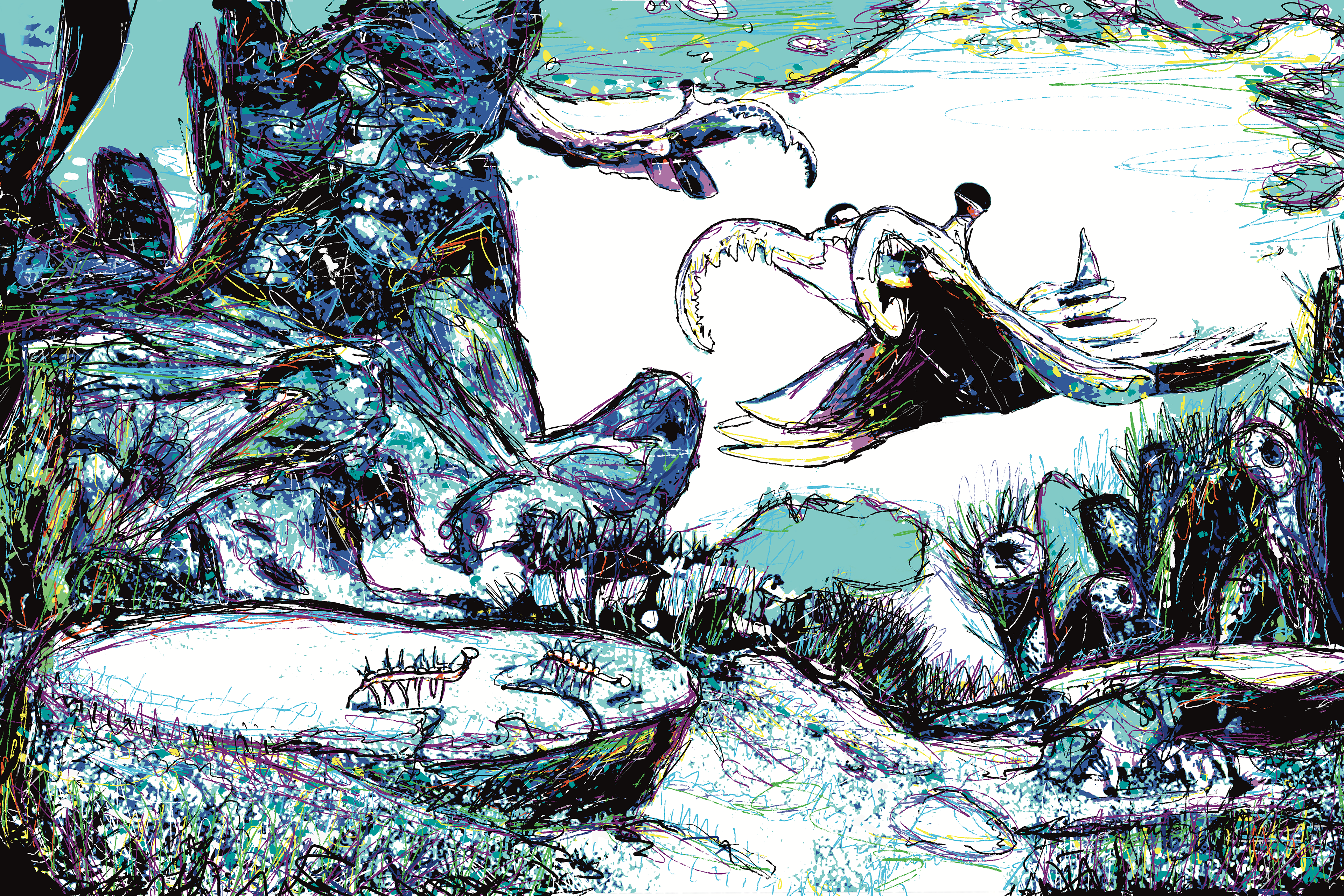
Cambrian - 541,000,000 years ago
The ancient stillness is cast aside,
And the unseeing days are passed into the deep.
In a sudden blooming, the earth’s womb is opened,
Bringing forth a host of creatures, strange and armored,
A world known only for slow and silent drift.
The waters were troubled by a new and sharp intent,
As eyes first drink the sun’s clear light.
The seabed; a forge of stone and strife,
Where the trilobite scuttles in its coat of hardened mail.
Peace in the garden is forever no more
Hunger has found its mark.
The shadows grow long with the coming of the hunt,
And life, in its frantic flowering,
Clothes itself in spines
ENTER CAMBRIAN- THE EXPLOSION OF LIFE
The Cambrian Explosion was less of a slow burn and more of a biological wildfire. In a tiny slice of Earth’s history—about 20 million years—almost every major animal group we know today suddenly showed up in the fossil record. It wasn't just more animals; it was a total redesign of life itself. Nature went from simple, soft-bodied forms to complex creatures with eyes, legs, guts, and hard shells. This was the era where predators like the massive Anomalocaris started the first real arms race, forcing everything else to adapt or disappear into the sediment. Our data of the Phanerozoic is the most extensive, which has allowed for many subdivisions within it. The beginning of the Phanerozoic is essentially when plants and animals become a thing during the Cambrian, or life as we know it. When we think of the GTS, we think of post Cambrian history as the most important. And this is valid, as fossils record post Cambrian have provided us with more data and evidence than anything pre-Cambrian ever could. The Cambrian explosion of life happened about 500 million years ago. Every animal and plant stems from some type of evolution that happened during this time. My issue here is that realistically, by the time we hit this point in the timeline, 88% of Earth's history had already passed.
-
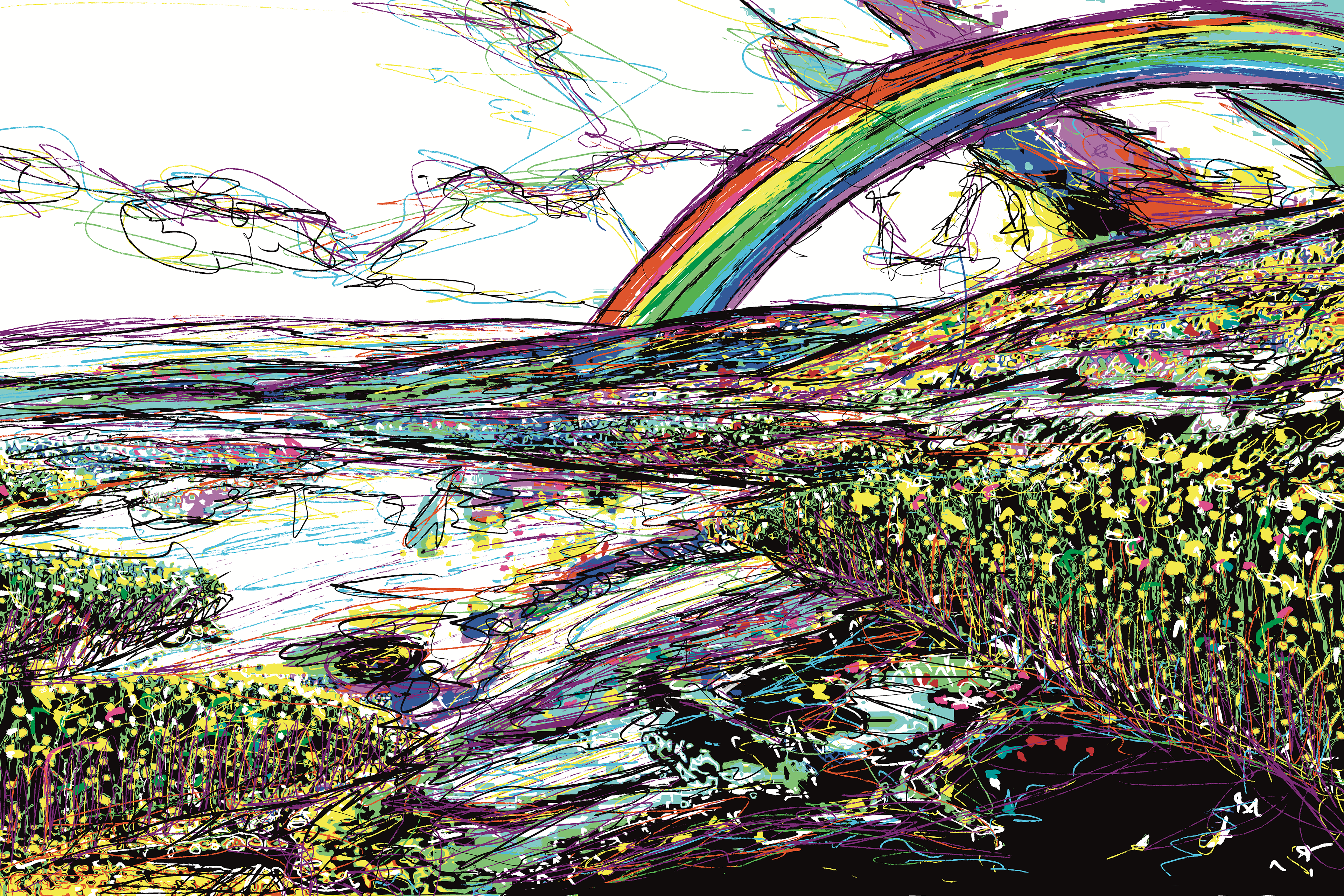
Ordovician - 485,000,000 years ago
A covenant of hues
Spans the rain-washed sky.
Beneath its arch,
The emerald land wakes in wonder,
Where the first humble mosses
And the yellow-blossomed herbs
Creep forth to claim the damp earth.
The waters, fractals like crystal
Mirroring the glory of the heavens in their steady flow.
The air becomes breath,
Nurturing the green life that clings to the river’s edge.
In this wide tabernacle of light and shimmering spray,
The barren stone is clothed in a garment of living gold.
ENTER ORDOVICIAN - INDIVIDUALITY IS JUST AN IMAGE: AND WE ARE ALL ONE
The Ordovician was a peak moment for the oceans, but it's also when we see the very first hints of life trying to make it on land. While the seas were full of massive reefs and strange tentacled creatures, the edges of the continents were just starting to turn green with primitive plants and mosses. I’ve tried to capture that brief, beautiful window of transition. a world flush with water and new growth just before the climate shifted and the first great mass extinction began to freeze everything over. The Ordovician was a time when the oceans really hit their stride, with massive reefs and a huge boom in diversity. Huge glaciers formed over Gondwana, which caused sea levels to plummet and messed up the chemistry of the water. Between the cooling and the loss of shallow sea habitats, about 85% of species were wiped out. It was a massive crash after a long period of life just flourishing everywhere.
-
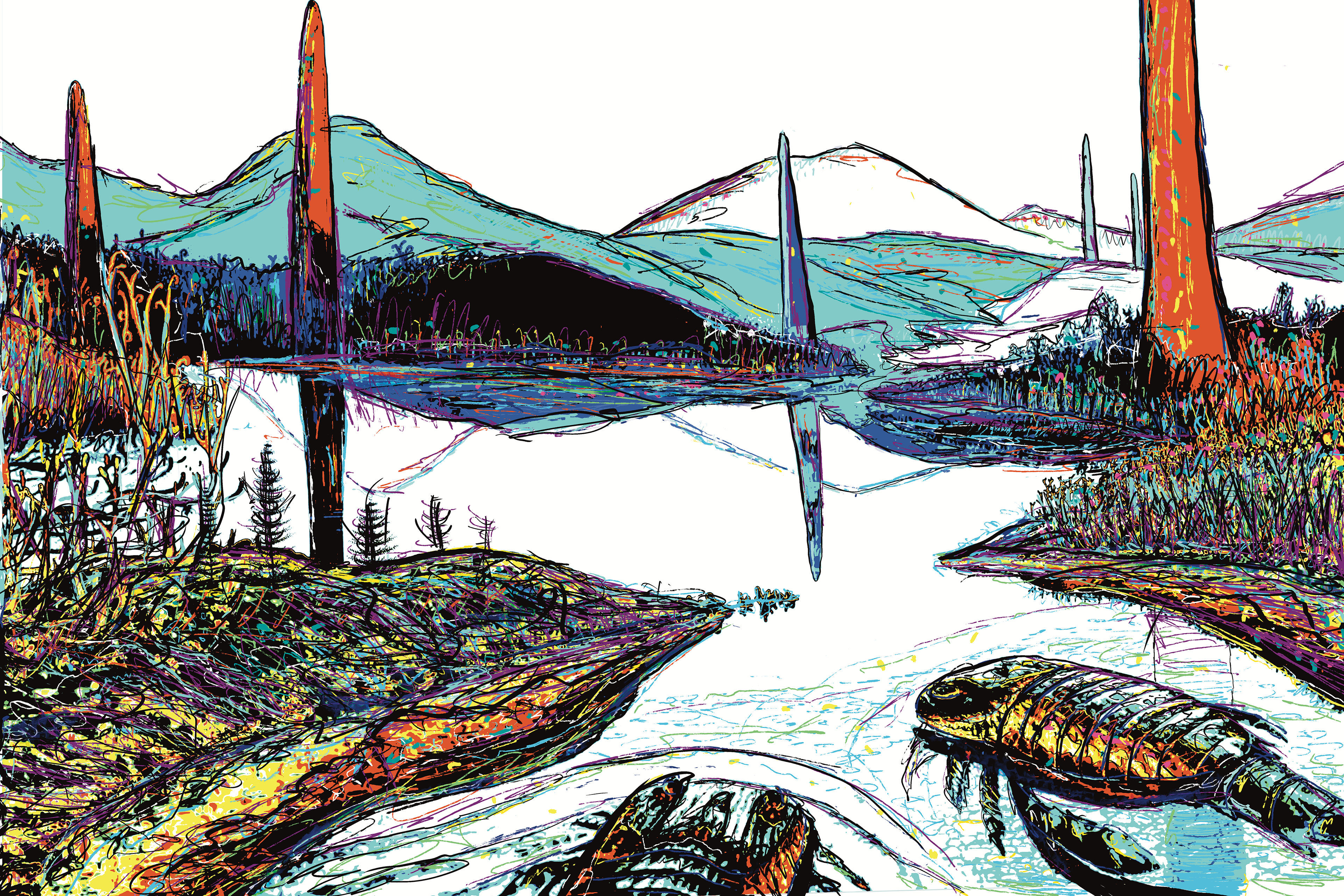
Silurian - 443,000,000 years ago
Upon the banks,
Strange and towering spires of fungus
Rise like sentinels,
Monuments of living stone reaching toward the sun.
The land is no longer a barren waste,
Green veins crawl along the margins of the river,
Claiming the mud for the kingdom of plants.
Within the shimmering glass of the flood,
The sea-scorpions glide with grace,
Their armored bodies reflecting the light of a world reborn.
The air is soft, and the mountains stand as witnesses
It is a season of beginnings
ENTER SILURIAN - MY TAXON RISES FROM ASHES : WE’RE SO BACK AND ITS SO OVER
The Silurian was all about recovery and expansion after the massive Ordovician extinction. The ice melted, sea levels stabilized, and life finally got a real foothold on land. The tall, pillar-like things in my image are Prototaxites, which were actually massive fungi that towered over the tiny, early plants. In the water, sea scorpions (eurypterids) became the top predators, prowling the shallow coastal waters while the first fish with actual jaws started to evolve. Life was very weird at this time. Earth was testing some new models out. Do you notice your veins look like lightning? That they resemble the lines on a leaf, or the flow of a river? I'm in the trees, I'm in the breeze, my footsteps on the ground. You’ll see my face in every place but you can’t catch me now.
-
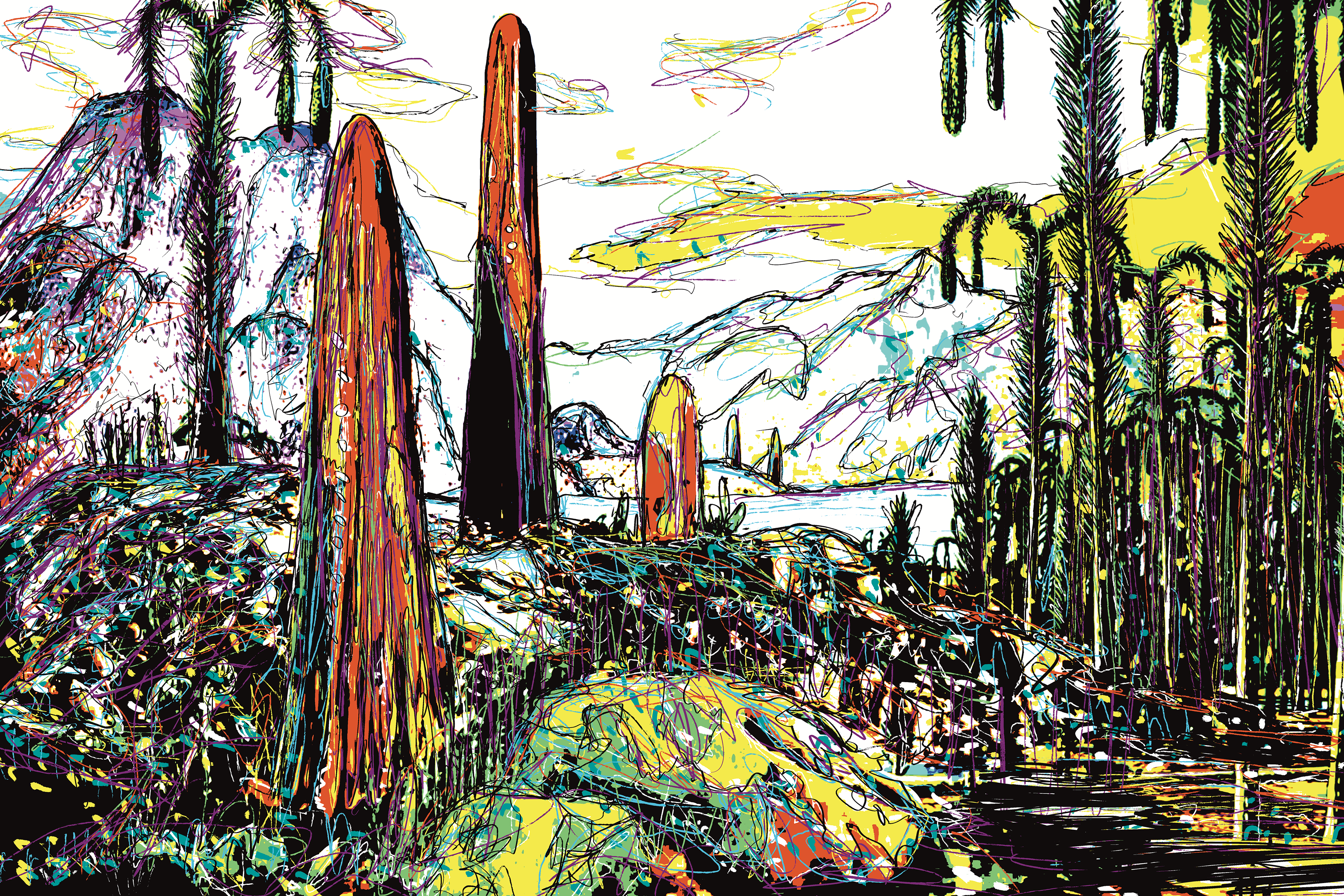
Devonian - 419,000,000 years ago
Mountains glow above many waters,
As the first true forests rise
No longer do the fungal towers stand alone
For the first trees spread its boughs,
Casting the first deep shadows upon the soil.
The land is a canopy of emerald and gold,
Where the breath of the leaves
Changes the very air.
You are my sun and my rain
Within the deeps,
The armored fish bask in glory
Lords of the sun-pierced brine
And the winding river-ways.
Yet a new and bold intent stirs
As the first four-limbed wanderers
Emerge from the flood,
Finding their feet upon the rooting earth.
The fin turned limb,
Where the kingdom of the ancient shore
It is won by the bold of heart.
Our memories from when we were lungfish together
Sucking in our earliest gasps of airs
Beneath the first trees
The forthbringers of oxygen
Our transition to land
ENTER DEVONIAN - MY LUNGS ARE SCREAMING FOR SKY AND MY FEET FOR EARTH
The Devonian is famously called the "Age of Fish," but it’s also when the land really transformed. This is the era of the first true forests, with trees like Archaeopteris began developing deep roots and wood for the first time. Those tall Prototaxites pillars from the Silurian were finally getting overshadowed by real plants. Most importantly, this is when our own ancestors, the first tetrapods, started hauling themselves out of the water and onto the mud, setting the stage for everything that lives on land today. It has happened. We made it!
-
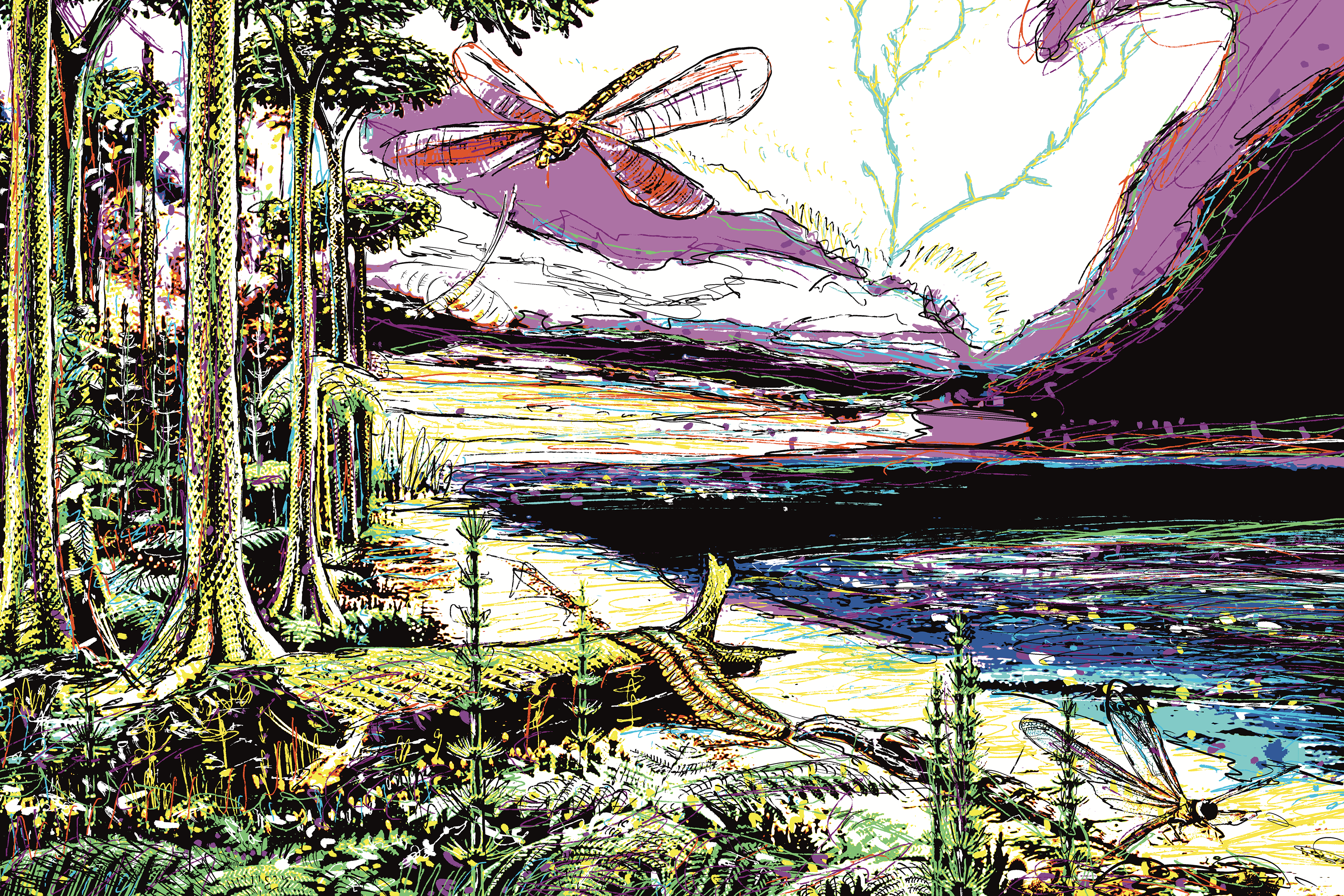
Carboniferous - 358,000,000 years ago
The atmosphere is heavy with an oxygenated wine,
Chemical cocktails fueling giants of the air.
If I was reincarnated, it is through the conservation of mass
The molecular essence that makes me up
Was once fixed in the wings of a bug
Whose grace was a measurement of the heat.
Now, those same atoms circle the planet
Over and over,
Driven by a redistribution of neutrinos
Moving at light speed,
Passing through the deep
When land was a tabernacle of green,
Where the towering trees scaled the mist,
Sequestering the sun in a burial of carbon.
In this land, Newton’s first law
Has not been proven untrue:
For every trunk that sinks into the peat,
There’s an equal manifestation of energy for a future yet to come.
Millions of moleculars passing through every one of us.
Every second; where the pulse of decay is slow,
Conversion from life into fuel,
That is burned, forgotten the waters,
Mirrors for primitive ferns,
Reflecting the flight of ancient ones
And the blurred lines of a chemical redistribution.
Is this the divine, or simply the law of manifestation?
The earth is a furnace of life, forging dark foundations
The lightning, the breath, the water, the silt.
We are the product of immense abundance and soaring scale,
Forging our modern selves from the prehistoric,
The molecular essence of a world that refused to disappear.
The smoke of burning coal that was once a leaf fills my lungs
ENTER CARBONIFEROUS - REOBSERVATION OF HISTORY ON LARGE SCALE SEEMS TO SPARK EXISTENTIALISM WITHIN MY THOUGHTS.
The Carboniferous was basically the Earth at its most lush and overgrown. At the beginning of Pangea, oxygen levels were way higher than they are now. Insects, for example, could grow to terrifying sizes. Like the Meganeura dragonfly, which was as big as a hawk. The whole planet was covered in these massive, swampy forests of tree-sized club mosses and ferns. When those plants died, they didn't rot away completely; instead, they got buried and compressed into the massive coal seams we still mine today. It was a high-energy, high-oxygen world that laid down the energy source for the Industrial Revolution millions of years later. Just about all the fossil fuel deposits we burn come from this time. We inhale the smoke of ancient bugs and ferns every single day.
-
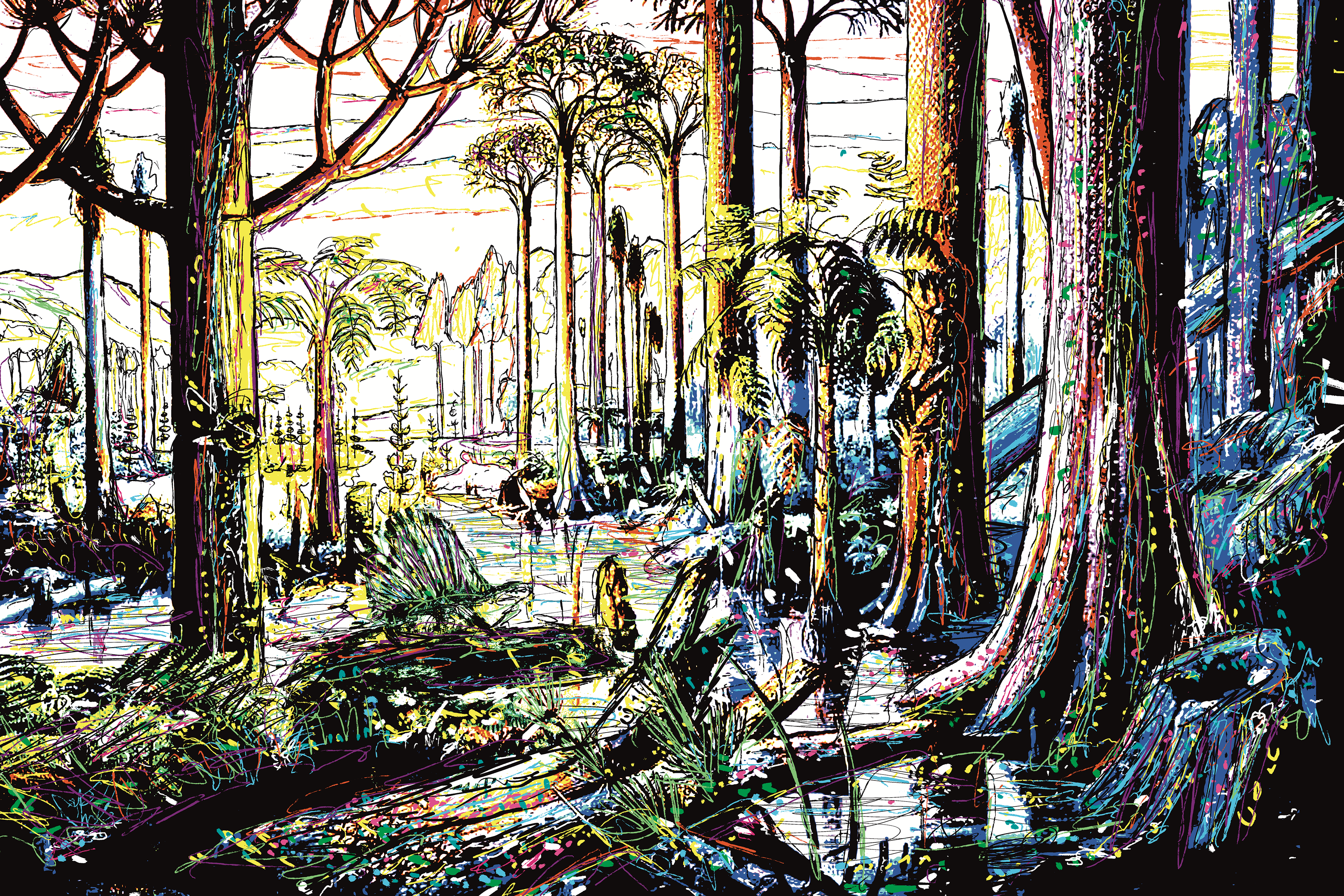
Permian - 289,000,000 years ago
The world of plants, the end of the worldwide jungle
The last sunset sets over the swamp
Yielding to an unrelenting heat.
Marsh begins to fray,
As the sky turns dry.
Every hue saying goodbye
The waters retreat into Earth.
The scaly kin of the dragon rise,
Moving with thermal precision
I watch the great Pangaea
Weld itself into a singular fist,
a continental monolith that traps the seasons in its grip.
The last wetlands, in their needle-clad armor,
Stand as grim sentinels against the encroaching dust,
Where life is no longer a soft, aquatic dream
But a hard-won struggle
It is the twilight of the ancient world,
A sun-scorched vigil before the Great Dying
ENTER PERMIAN - MY HEART IS BIGGER THAN A SUPERCONTINENT
The Permian was the final chapter of the Paleozoic Era, defined by the formation of the supercontinent Pangaea. This massive landmass caused the interior to dry out, putting an end to perpetual Carboniferous swamps and paving the way for the first ancestors of dinosaurs and mammals to take over. It was a time of extreme climates. Edges of the crust covered in dying marshlands merging against hot, dry deserts and seasonal shifts. It all ended in the "Great Dying," a mass extinction so brutal it wiped out about 95% of all species on Earth, nearly resetting the clock on life entirely.
-
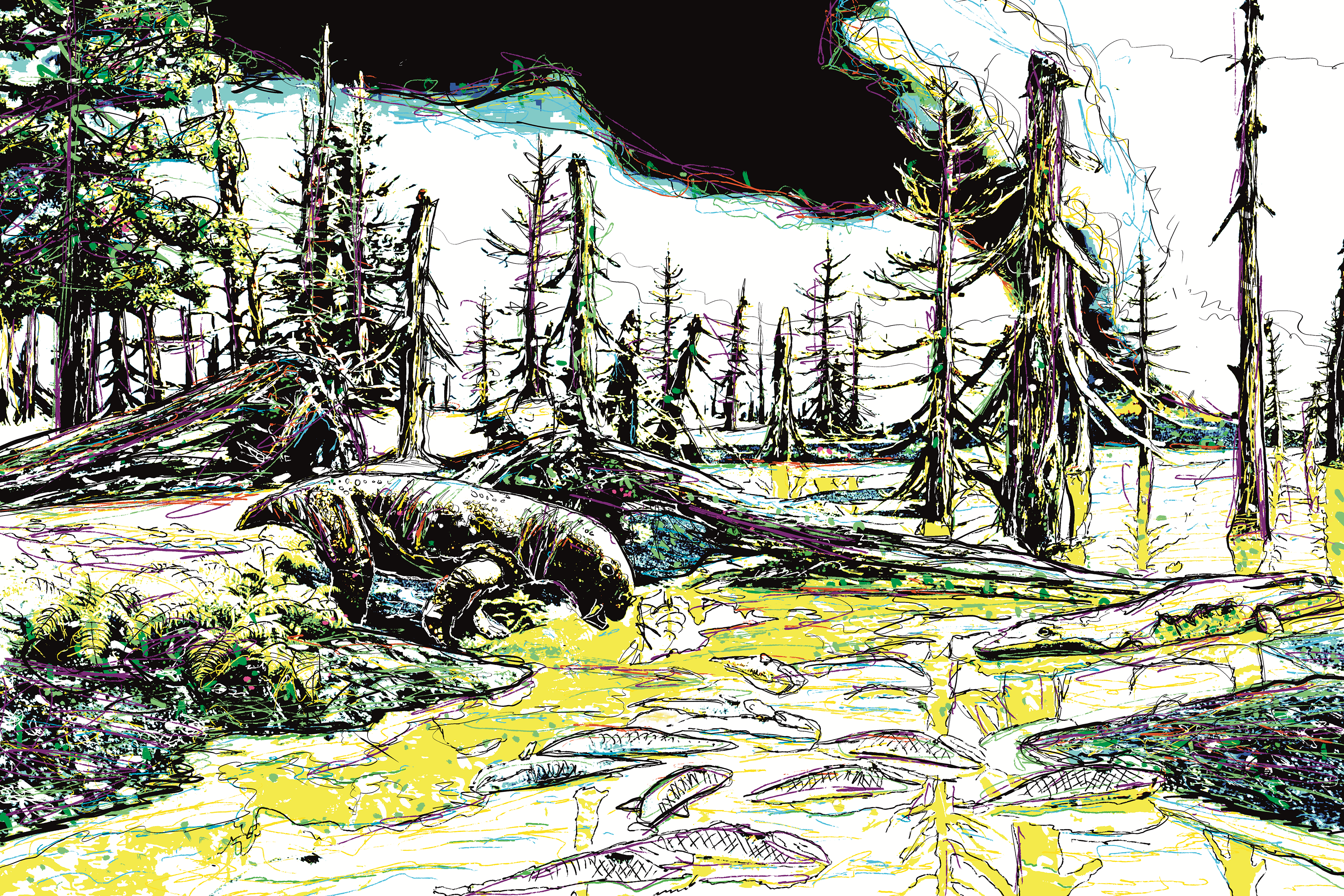
E. Triassic - 251,000,000 years ago
He’s watching over a landscape of skeletal wood
And stagnant pools.
The great furnace of the dying world has finally cooled,
Leaving behind silence
Amidst the ruin of a billion years,
The survivors emerge
The small, the hardy,
The resilient ghosts of the ash.
He bows its thick head
To the brackish stream,
Drinking from a water that remembers the fire.
There is no majesty here yet,
No thunder of heavy feet
Or the glint of a predatory eye,
Only the slow, rhythmic crawl of life starting over
In the green morning of a shattered theater.
I watch the time pass
Knowing that just about everything that has ever lived, has died.
And that is okay.
I do not want the graveyard or the flame;
I will rather lie here in a shallow sea
Letting the sand and the sediment claim me
This is the best way to become a fossil
Becoming one with the stone in a mineral trade.
I will rejoin with the earth
And become a rock
While my memory lives deep inside this planet
And I join the quintillions
That have done just the same
ENTER EARLY TRIASSIC - EVERYTHING IS POISON AND I AM TOXIC
The Early Triassic was a planetary recovery ward. After the "Great Dying" at the end of the Permian, the world was nearly empty and the climate was a mess. The great dying was Earth's most severe mass extinction. It wiped out almost every marine species and 3/4ths of terrestrial ones. It was due to intense volcanic activity that literally turned the air and oceans into acid. Creatures like Lystrosaurus were the ultimate survivors; for a while, they were one of the most common land animals on Earth simply because they were tough enough to endure the low-oxygen, high-heat environment. It was a humble beginning that eventually paved the way for the more famous reptiles to follow.
-
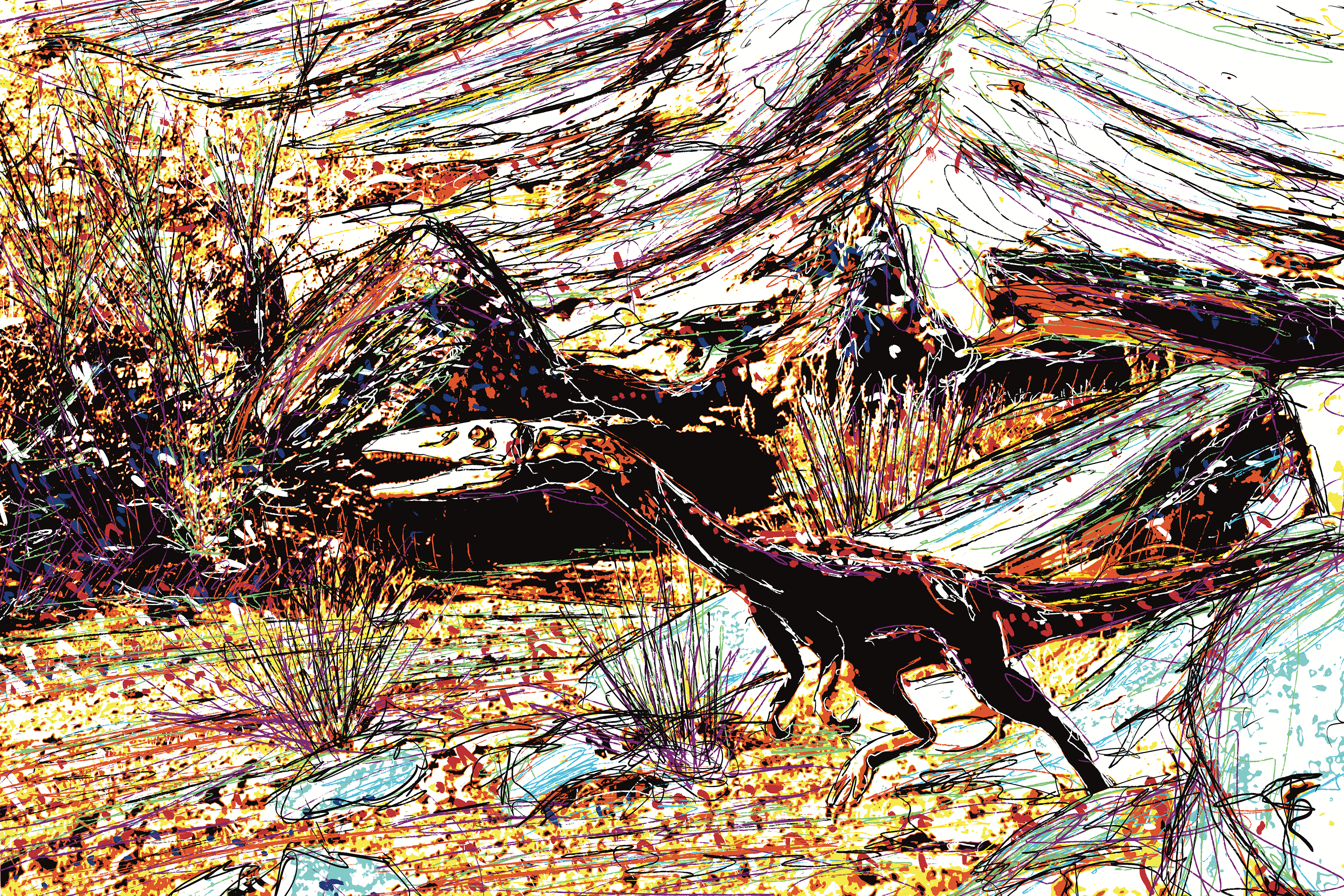
L. Triassic - 237,000,000 years ago
The great fist begins to loosen its grip,
The continental monolith cracking
Under the strain.
Vast, arid basins stretch between seams,
Where the sun-baked stone reflects time
Across this singular,
Endless stage of dust
Transition from a world of recovery
To sharpen teeth and hollow bones.
The monolithic heart of the land is a furnace of wind,
Sweeping through the plains
In the shadow of the mountains,
Navigating the vast, unyielding interior of a continent
The giants are stirring in the dust
As the old unity breaks to make way for the age of kings.
ENTER LATE TRIASSIC - HELIOS SCORCHES THE EARTH: HAVE YOU PLAYED ARK?
The Late Triassic was dominated by the supercontinent Pangaea, which was so massive it created extreme, desert-like conditions in its center. As the era progressed, the land began to rift and pull apart, a process that eventually formed the Atlantic Ocean. This tectonic instability, combined with a surge in volcanic activity, led to the end-Triassic extinction. While it was a disaster for many groups, it cleared the board for the dinosaurs to expand and diversify as they moved into the Jurassic.
-
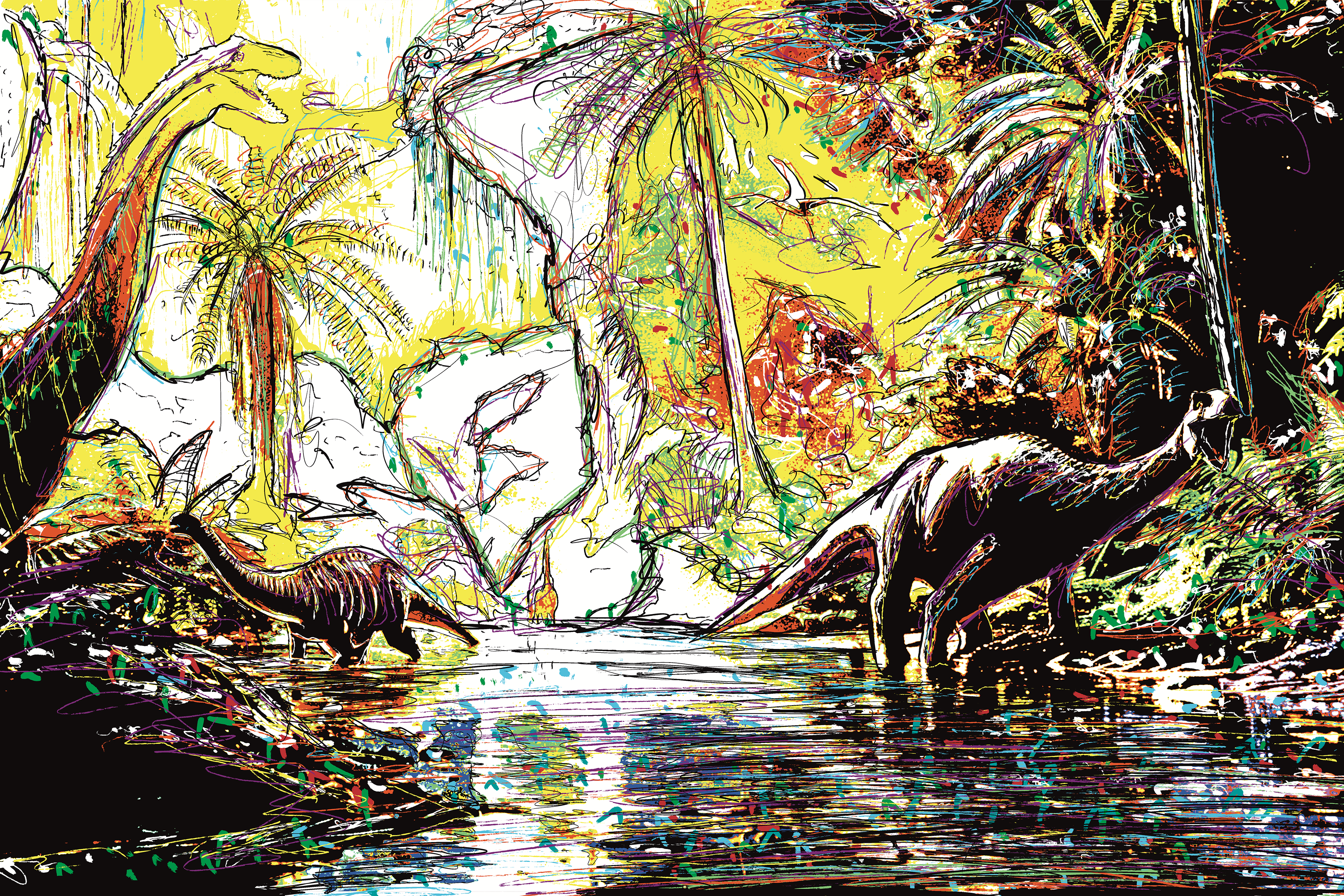
E. Jurassic - 201,000,000 years ago
We are product of all that surrounds us
Our distinctions tell our story
We are a billion year old carbon
Made of stardust , golden
Maybe all that’s important has already happened,
Any notion of progress is a sham, but nonetheless
We see our future in the corners of a spider web.
The fractured heart opens wide,
As the rifts swallow the ancient dust.
A new breath
Sweeps across the vales,
Nurturing a world of ferns and palms
Where once the parched and thirsting desert lay.
Upon the river’s edge,
The giants begin their walk
Their footfalls echoing
The air is thick with the scent of growth and rising sap,
The mountains of stone are clothed in leafy veils.
The singular landmass couldn’t keep the tides at bay;
The world is a tapestry of islands and of widening seas,
Where the manifest destiny of the tall
Is written in the Jurassic groves
ENTER EARLY JURASSIC - RIFTS TEAR THE WORLD IN TWO
The Early Jurassic was a time of massive environmental shifts as the supercontinent Pangaea finally began to break apart. This rifting allowed moisture to reach the interior of the continents, turning those old Triassic deserts into lush, tropical paradises full of ferns and cycads. Dinosaurs took full advantage of this new abundance; prosauropods and early sauropods started to reach incredible sizes, while agile predators began to specialize in this crowded, green world.
-
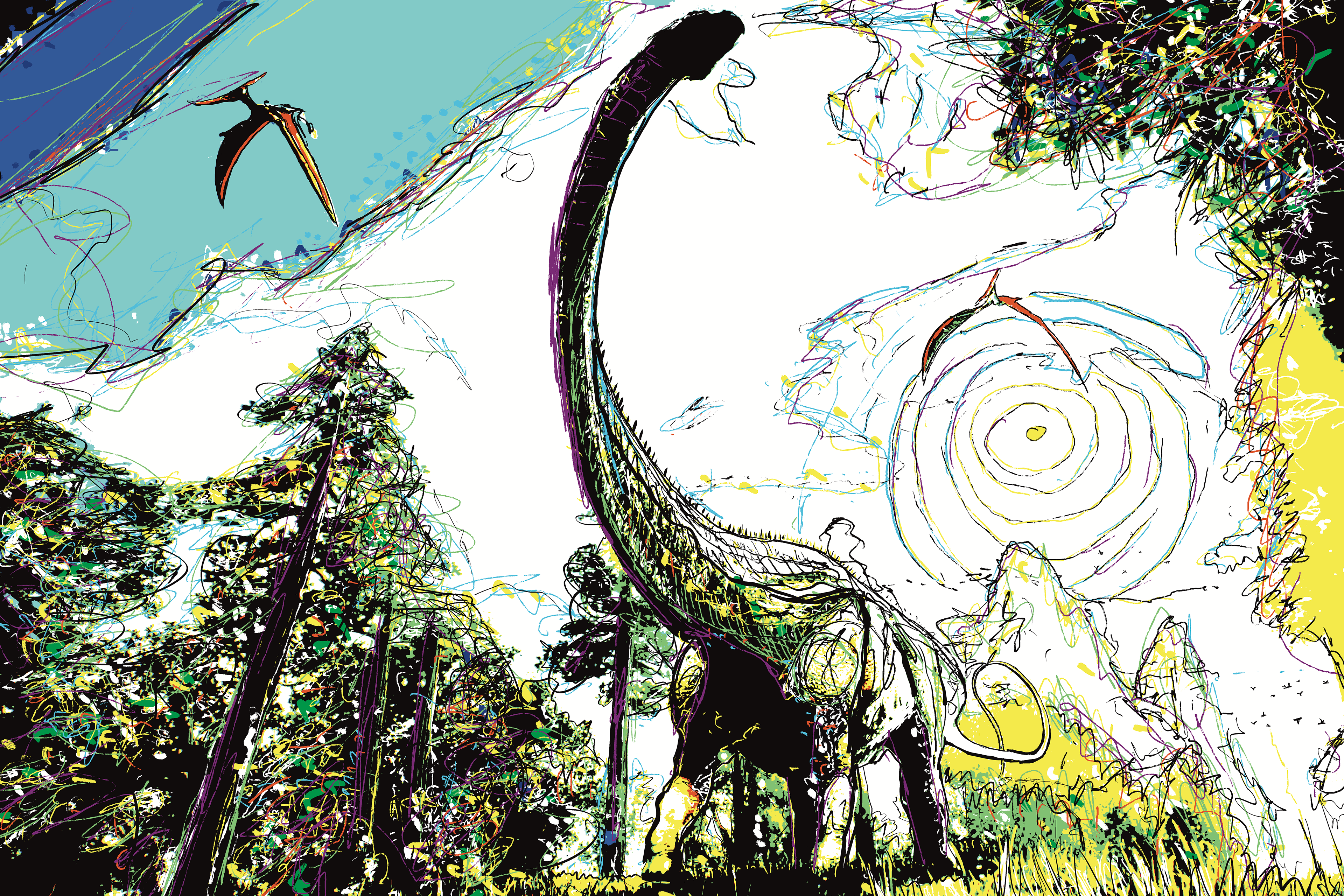
L. Jurassic - 163,000,000 years ago
The horizons have expanded
Long-necked titans reach for the sun’s white eye.
High above the canopy of the sky bound pines
To graze upon the clouds and needles.
The sky is no longer empty,
But a path for the winged ones,
Who circle the sun in a slow drift.
Below, the ferns are carpeted beneath the giants
Thankful for brilliant,
gold light of a mature age.
The rifts have widened into vast and turquoise seas,
But here, in the heart of the forest, the scale is absolute,
And the silence is broken only by the heavy breath of kings.
Summit of an age,
The hour of the mountain-flesh,
Where the architecture of the animal has reached its peak.
The world is a sanctuary,
Wow, a sun-lit cathedral where the atoms of the past
Are woven into the pulse of saurians,
Lucky to be ruling a land that has forgotten the cold and the ash.
ENTER LATE JURASSIC - THE GIANTS STILL WHISPER TO ME:
The Late Jurassic was the absolute peak of the giant sauropods. Massive creatures like the Brachiosaurus used their incredible height to reach food sources that no other animals could touch. The continents were continuing to drift apart, creating a warm, stable climate that supported these enormous calorie requirements. This era also saw some of the most famous dinosaurs, like Allosaurus and Stegosaurus, living in a world that had finally become a fully realized, high-definition masterpiece of evolution.
-
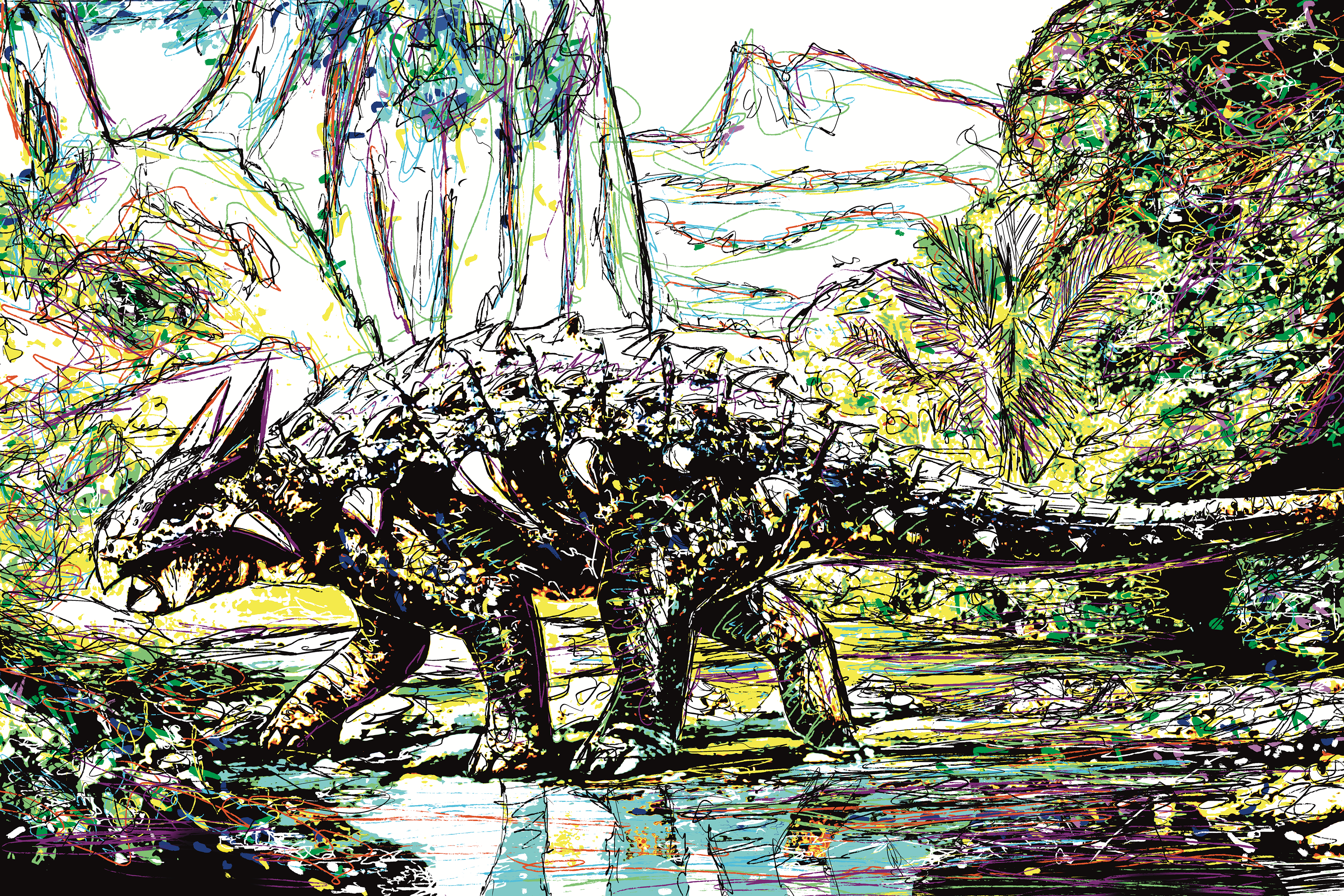
E. Cretaceous - 145,000,000 years ago
Flesh and spine
Move with the weight of a mountain
A coat of chain mail
The waters are a shimmering glass
For the armored knight,
As he wanders through a land
Of shifting leaves and rising peaks.
No more is the forest a sanctuary
Of soft peace;
The breath of the first blossoms,
A scent of change that drifts upon the winds.
ENTER EARLY CRETACEOUS - I START BLOOMING THIS TIME OF YEAR TOO
The Early Cretaceous was a massive turning point where life started to get a lot more defensive. Dinosaurs like the Gastonia developed incredible body armor to survive a new generation of smarter, faster predators. This was also the era when the first flowering plants (angiosperms) appeared, totally changing the look of the landscape. The world was becoming more modern, with the continents drifting even further apart and life evolving into the specialized forms that would eventually lead to the end of the age.
-
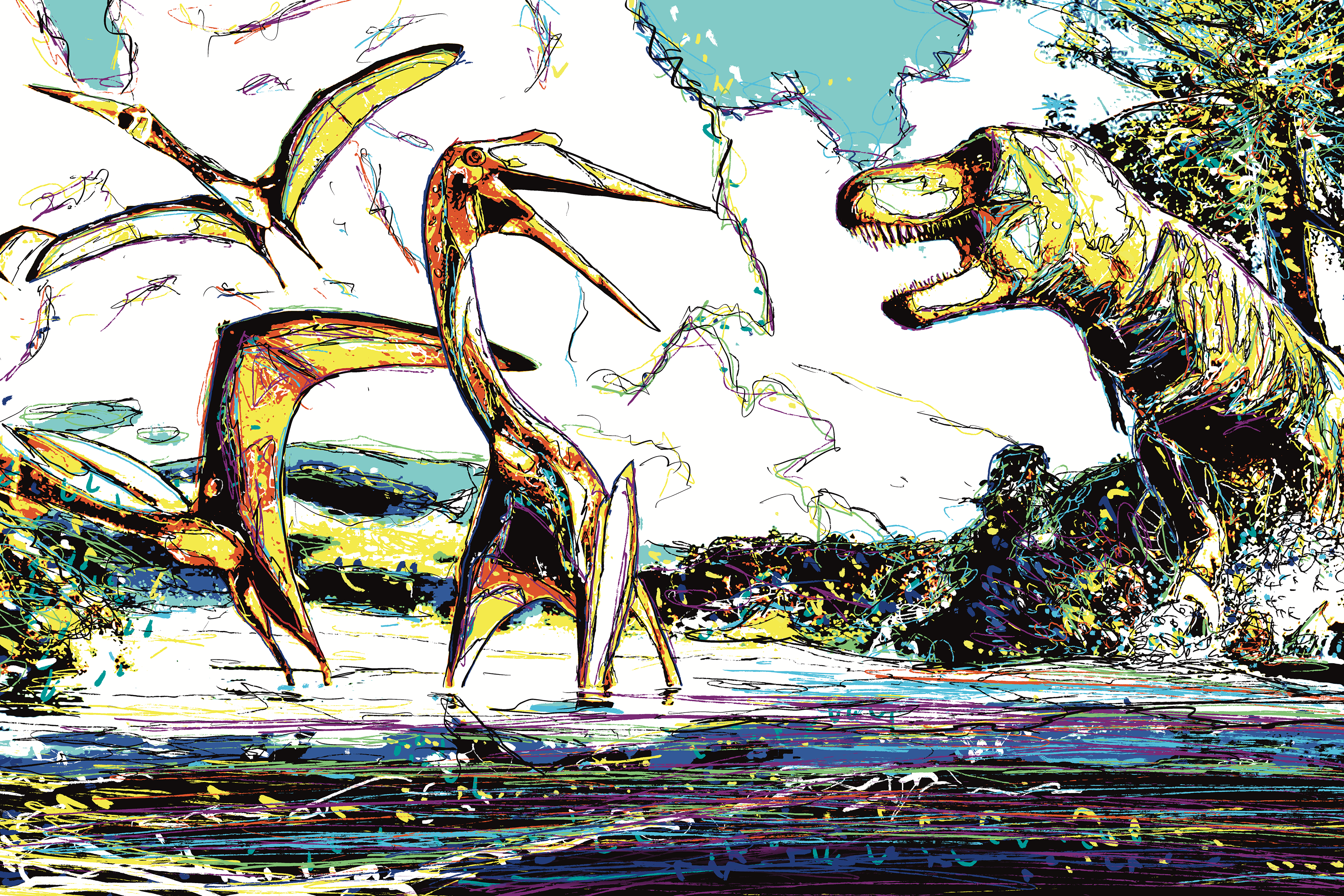
L. Cretaceous - 100,000,000 years ago
The air is thick with the scent of pine
And the first heavy blooms,
A world at the height of its terrifying,
Sun-drenched power.
A golden light washes over the river’s edge,
Where the tyrant emerges from shadows,
His presence a sudden weight
There is no silence here
Just the low, guttural vibration
Of a king claiming his shore.
In the shallows,
The winged giants stand tall,
Their hollow-boned frames draped in a leathery, iridescent skin.
They tilt their spear heads toward the sun,
Ready to launch into a sky that belongs to them alone,
While the water reflects the glint of a predator's eye.
It is an era of absolute scale, where the muscle of the land
Meets the effortless, soaring grace of air shifters.
ENTER LATE CRETACEOUS - MERGE INTO PRIMORDIAL FORM
The Late Cretaceous was the grand finale of the dinosaurs. North America was split by a massive inland sea, and the land was covered in a mix of ancient conifers and newly evolved flowering plants. This was the age of specialists: The Tyrannosaurus R. as the ultimate apex predator, while massive pterosaurs like Quetzals took to the skies. The beasts of Cretacea knew nothing but a high-stakes world where life had reached its most extreme and specialized forms.
-
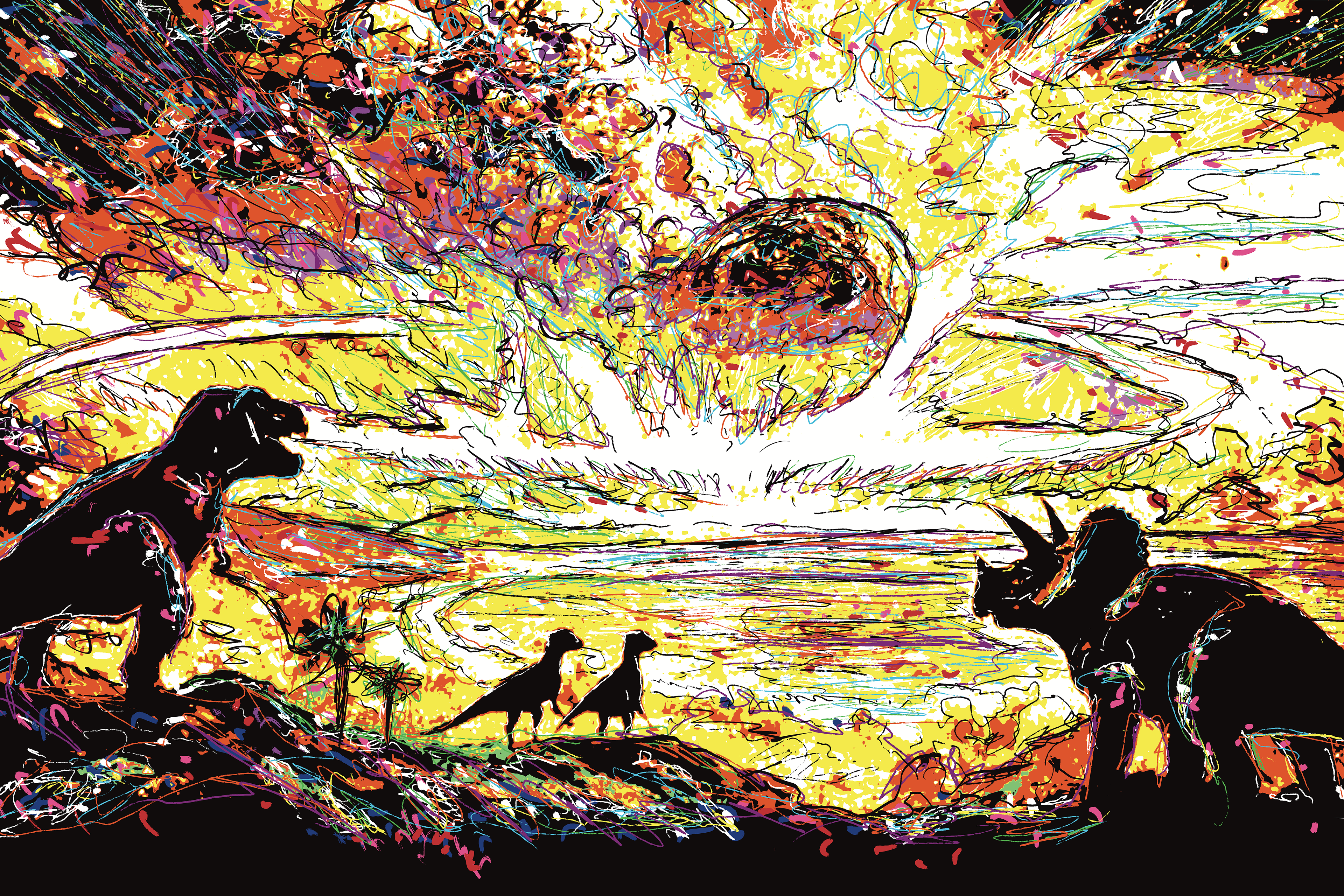
Paleocene - 66,000,000 years ago
A jagged sun.
Shadows stretch, then snap.
The titans, dark against a bleeding sky,
Witness the scribbled fire.
Chicxulub strikes.
The roar of ages, killed.
Dust blankets the heat.
The crown of scales falls
Its emotional
But atleast our mammal ancestors
Little rodents that took this time
Rising quiet and small
From the ruins of the great.
ENTER PALEOCENE - I’M BATTLING WITH: THE PASSAGE OF TIME
The Paleocene began in the brutal fallout of the asteroid impact. After the initial blast, a massive shroud of dust and soot choked the atmosphere, blocking sunlight for years and causing a global "impact winter." This collapsed the food chain, finishing off the dinosaurs and leaving a scorched, empty world. As the dust eventually settled, the Earth turned into a humid greenhouse. The survivors, mostly small mammals and birds, emerged into this hot, empty landscape, rapidly evolving to fill the void left by the extinct giants. Our ancestors rose from the ashes this period of time, and fought to live so hard. Enter the Mammal.
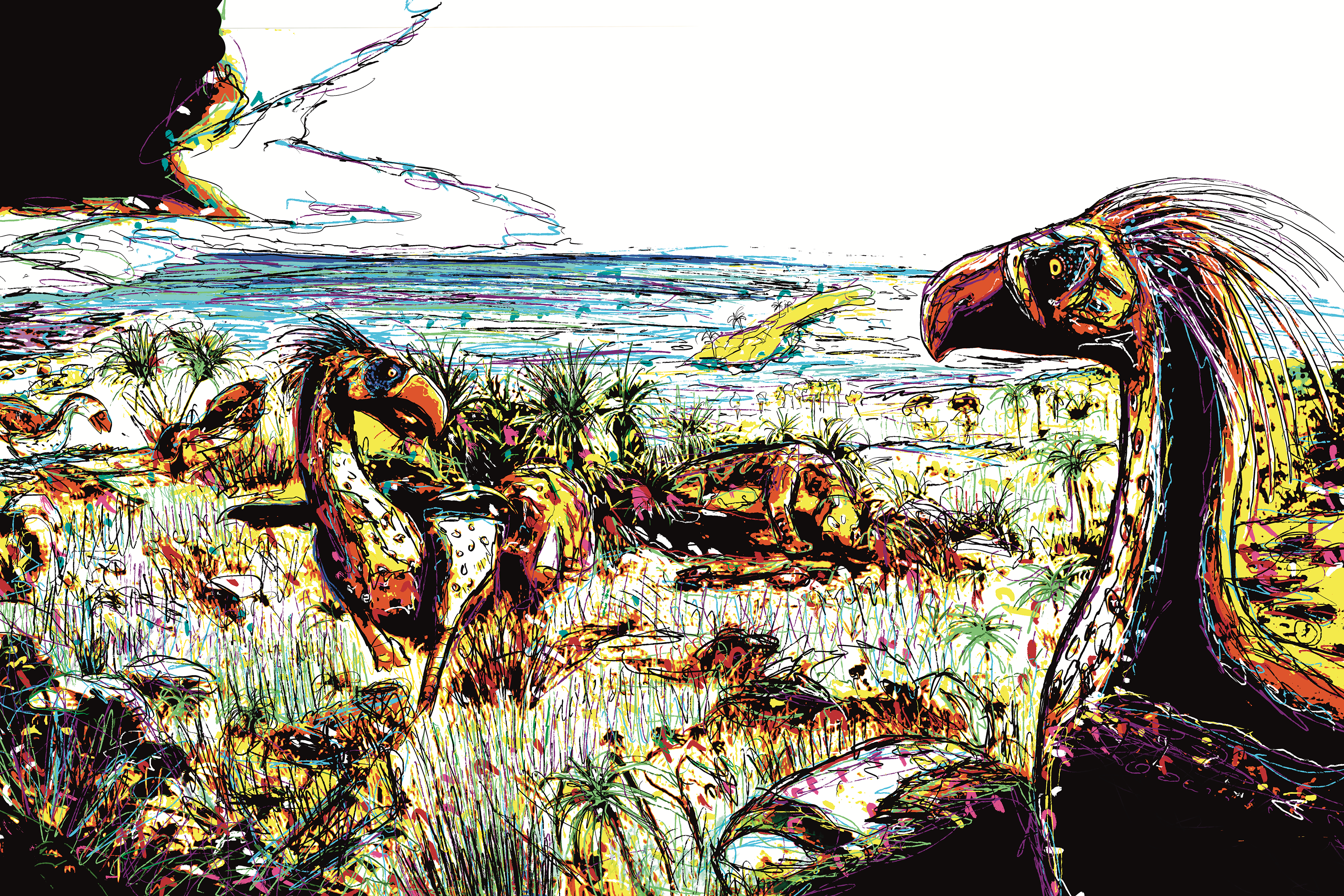
Eocene - 56,000,000 years ago
A new world.
Sunlight filters through dense steam.
No longer giants, but feathered remains
The birds, with hooked beaks and sharp eyes,
Claim the tall grass.
The scribbled fire is gone,
Replaced by a thick, green heat.
The land stretches, green and wide,
Under the rule of the swift and the flightless.
ENTER EOCENE - EVERYTHING YOU LIKED I LIKED 50 MILLION YEARS AGO
a time of extreme global warming, this created a world of lush tropical jungles that stretched almost to the North and South Poles. The fallout from the asteroid was long over, and the planet was now a crowded "greenhouse world" where mammals and giant flightless birds, became the new top predators. It was during this era that the ancestors of modern horses, whales, and primates first appeared in the dense, steamy days. In the world of the internet, surrounded by servers, I think of the hominids from long ago. I think they will miss the point.
-
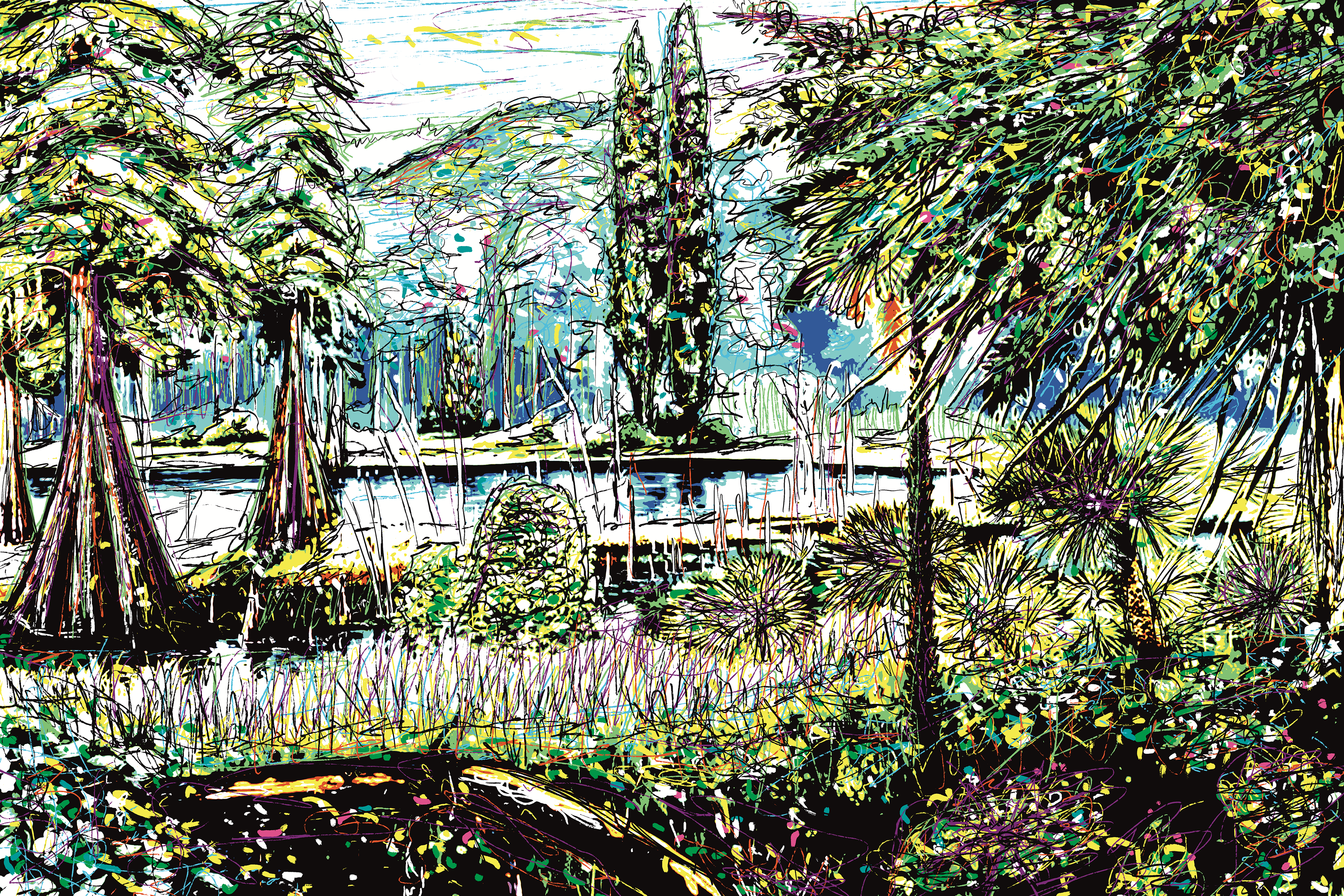
Oligocene - 33,000,000 years ago
From lands before we knew what
Time was, by a long reach of river at high tide, where
You can walk to conch shell mounds
Cross sea beds to vanish into the Island.
Here, in thick moss understory, poison ivy climbs up chestnut trees.
The trunks stand.
Dark waters still and deep,
A mirror to the tangled brush and reed.
The wild wood thins at the edges,
Yet the ancient cypress bids the sun please stay.
Admittedly, the thicket holdeth its breath,
For the world will be cold
And the grasses creep in.
ENTER OLIGOCENE - DAILY AFFIRMATIONS: I CAN LEAVE AND BE HAPPY
The Oligocene was a world in transition, where dense, marshy forests began to give way to more open land. While huge trees and wetlands still dominated parts of the landscape, the planet was cooling down, causing the tropical jungles to retreat toward the equator. This drying out created the first big openings in the forest, allowing early ancestors of modern mammals to move out of the thick shadows and into the sunlight of the emerging plains. The first primates were beginning to think.
-
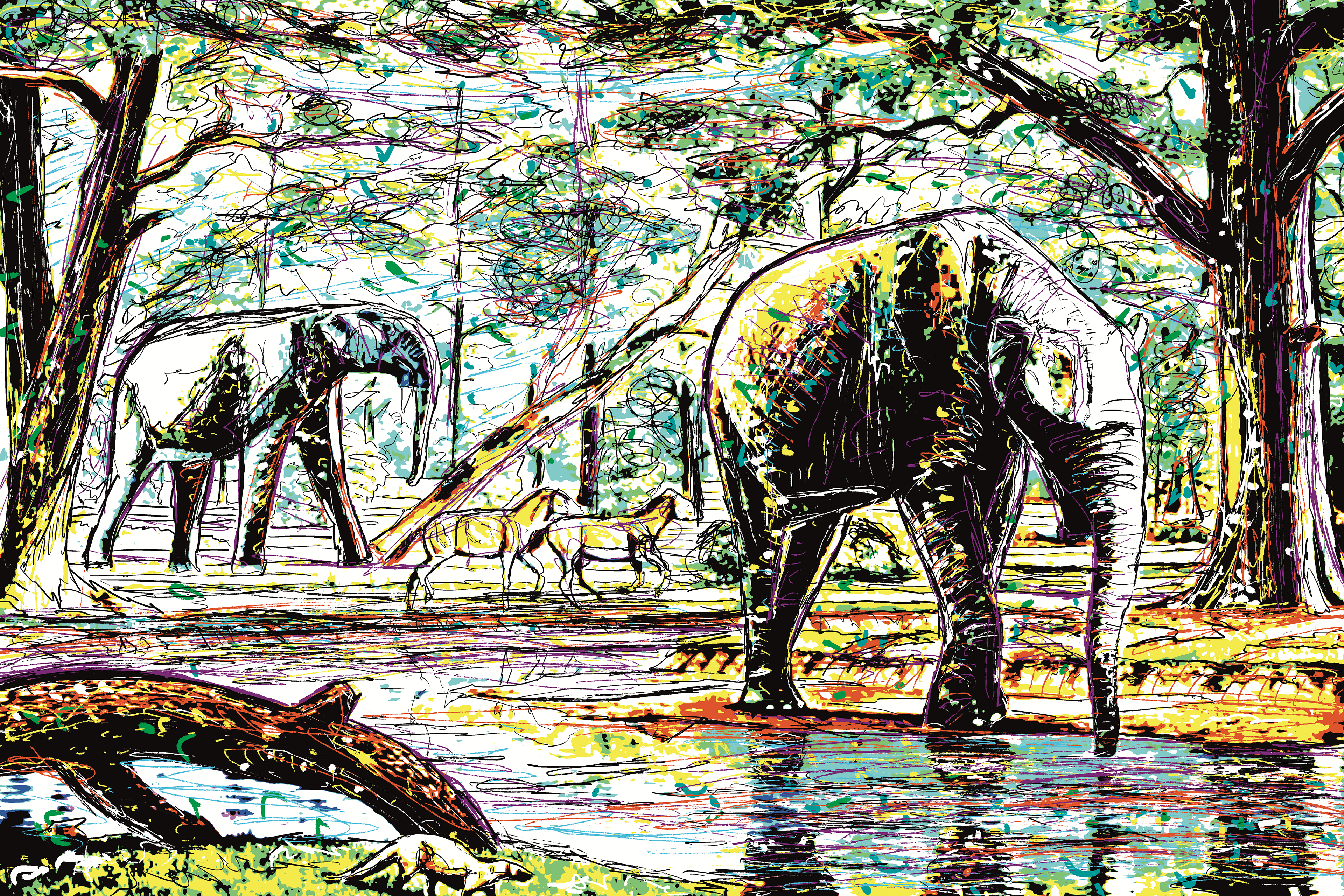
Miocene - 23,000,000 years ago
The wood is bright and thin.
Through the dappled light,
The gray giants tread,
Their heavy footfalls echoing in the clearing.
The wild grass rose beneath their weight,
As swift, small shapes race toward the treeline.
A world of sun and space,
Thankfully
And to them,
Finally,
ENTER MIOCENE - TO YOU ITS A UFO: I KNOW WHAT IT IS
Welcome the age of grasslands, where the Earth's cooling climate finally broke the old jungles apart. This era saw the rise of massive animals like early elephant relatives and swift, horse-like creatures that could run across the new, open prairies. This was a critical turning point because the spread of vast grasslands forced animals to either grow much larger for protection or become much faster to survive in the open sun. How strange is it to be anything at all?
-
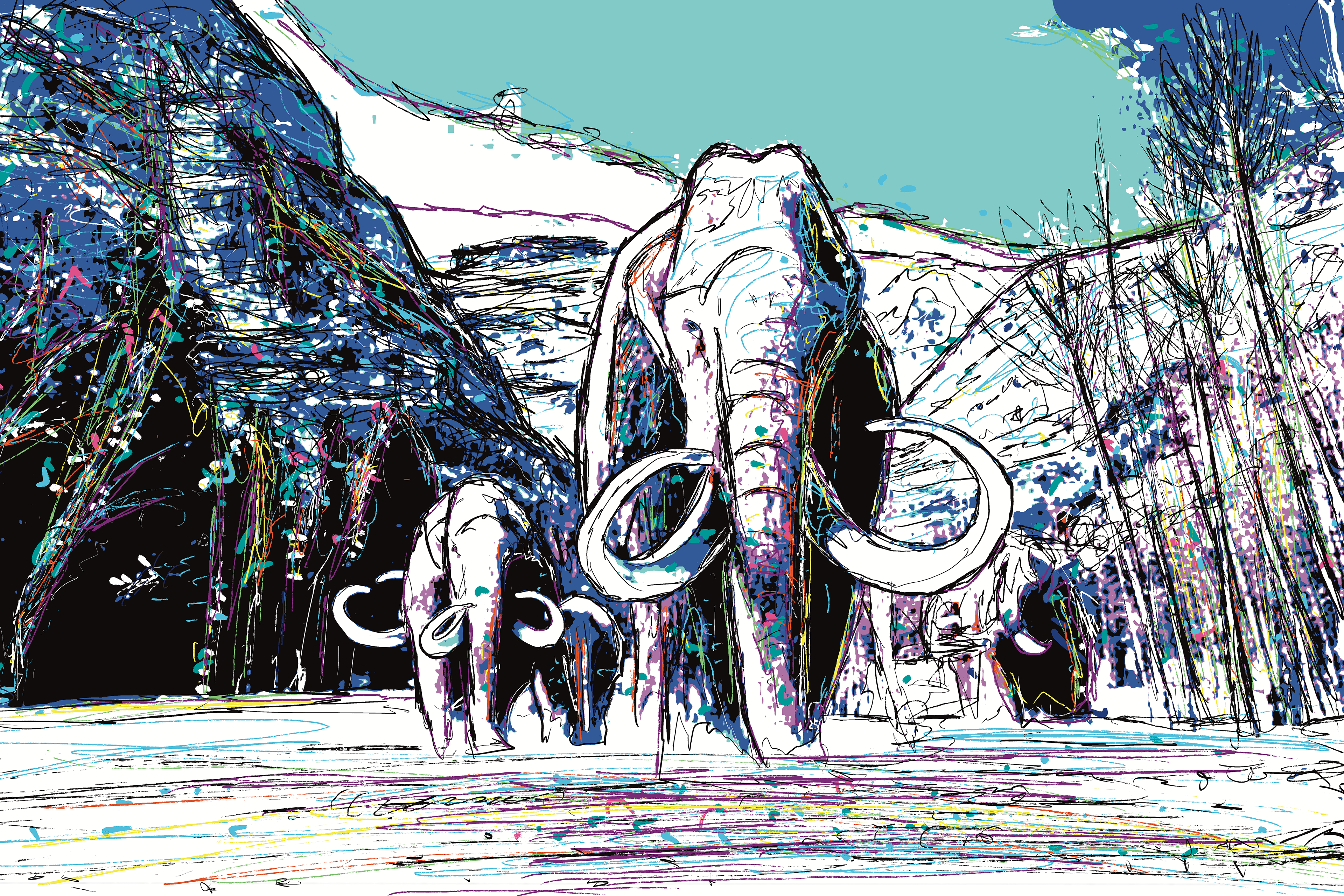
Pleistocene - 2,580,000 years ago
The world became white.
From the north, the biting breath of glaciers,
Locking the waters in a grip of iron
Gigantic shadows,
Clad in coats of shaggy wool,
Tread across the frozen tundra and the barren steppe.
Gone was the jungle’s heat,
But a pale sky,
The giants of ice and snow
Wander the white expanse.
ENTER PLESITOCENE - ANCESTORS, GUIDE ME : OK, HUNT MEGAFUNA TO EXTINCTION
A time of ice ages, where massive glaciers covered up to 30% of the Earth's surface. As huge amounts of water froze into these ice sheets, sea levels dropped significantly, which was uncovering new land bridges that allowed animals and early homininds to migrate across the globe. This era was famous for its "megafauna” , giant animals like the woolly mammoths, saber-toothed cats, and massive ground sloths that adapted to the cold. By the end of this epoch about 11,700 years ago, most of these giants went extinct as the climate warmed to accept the interglacial and humans began to spread more widely.
-
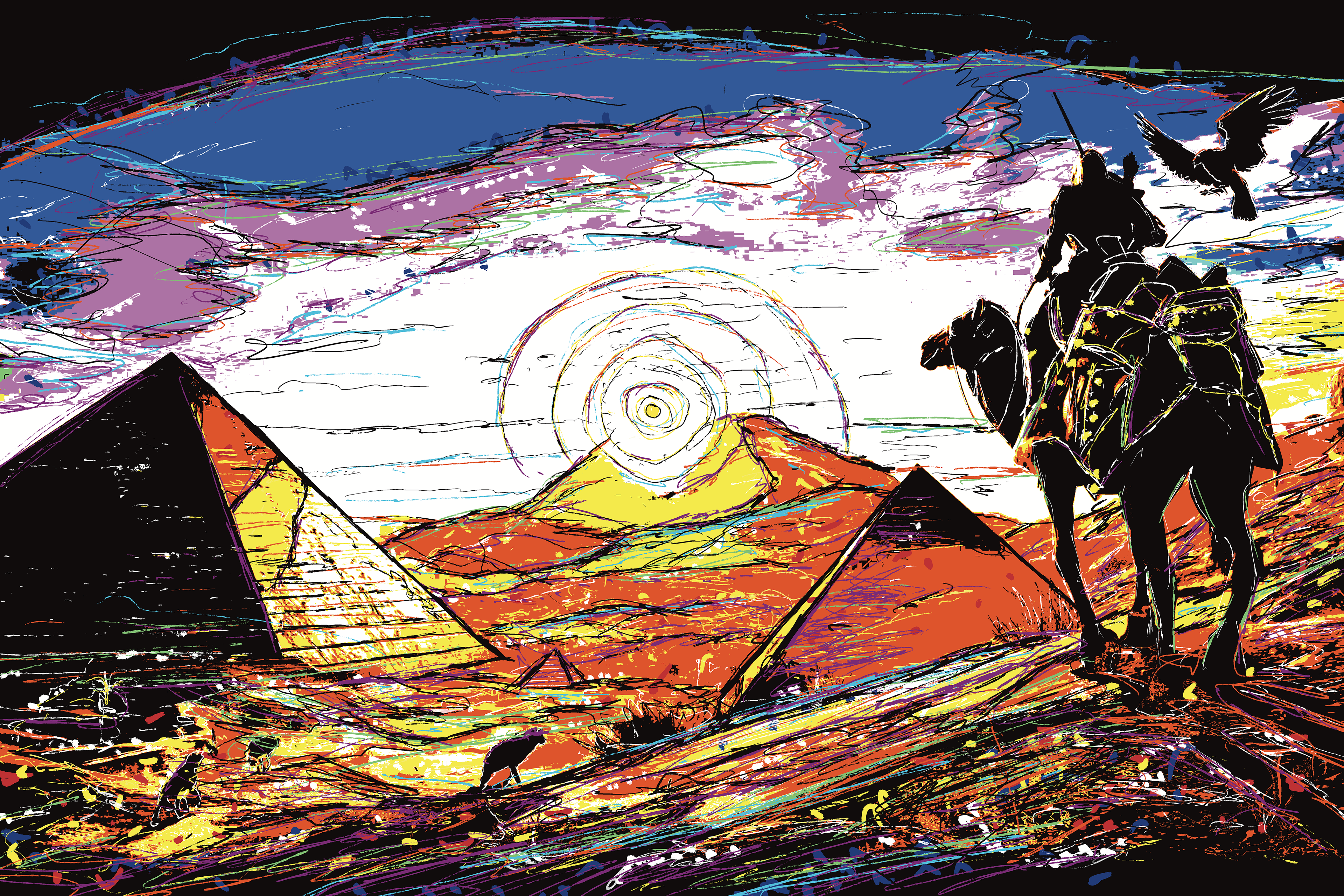
Holocene - 12,000 years ago
The ice retreats, surrendering the plains,
As golden sands replace the melting flowers.
Across the dunes,
The traveler and his humped companion go.
A bird of prey,
A speck of midnight ink,
Flies slow circles in the burning air,
While at the desert’s edge,
Where sunbeams sink,
The stone peaks rise
Behold these mountains built by human hands,
Sharp triangles of gold against the red.
The scribbled sky, in swirling purple bands,
Proclaims that nature’s wilder age has fled.
Gone the thunder of the mammoth’s
The desert blooms with monuments
Basking in the ring of a constant day.
ENTER HOLOCENE - I SEE THE PLAYER YOU MEAN
The Holocene is the official era we live in now, starting right as the glaciers pulled back and the world warmed up. This is the interglacial period. The stable climate allowed humans to move beyond just surviving and start building massive, lasting legacies like the pyramids. It is the age of domesticating animals, farming the land, and the rise of the first great cities. In this epoch, humans became a force shaping the Earth, turning the wild landscapes of the past into modern civilization. Self awareness and constant introspection doesn’t make you smart or intellectual, it only leaves you prone to decision paralysis and impulsivity. Bask in your instincts the same way so many others did. Over-analysis gives you an illusion of control, it is the absence of action. Take it from me. The more I learn the less I know I know. That is ok.
-
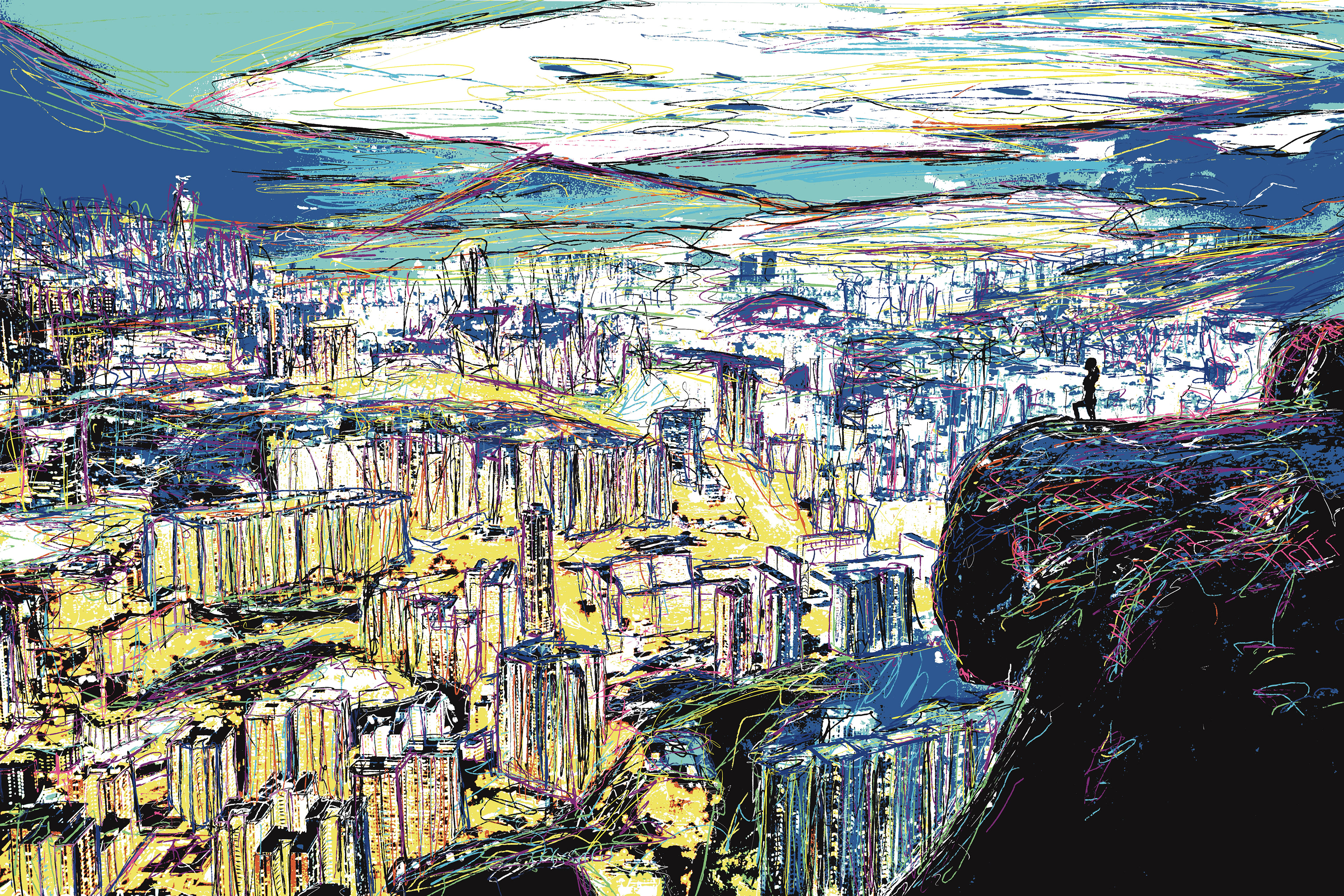
Anthropocene- 76 years ago
The stone peaks of old
Are eclipsed by the new,
Glass towers that scrape
At a smog-shrouded sun,
While the bird of prey circles a sky once blue,
Fleeing the world that man’s hands have undone.
The wild heart of nature is measured and sold,
The forests are quieted,
The oceans grow warm.
No longer a story of silver and gold,
The Anthropocene is the weight of our reign,
Where the fate of the earth and the human are tied.
ENTER ANTHROPOCENE - MY HEART DOESN’T KNOW MY BRAIN NAMED ITSELF
The Anthropocene is a proposed unofficial epoch, starting a few decades ago about 75 years ago, defined by the massive and permanent impact humans have on Earth's geology and ecosystems. Unlike the previous eras where nature dictated life, humans are now the main force driving climate change, mass extinctions, and the reshaping of the land. A world of cluttered horizons, where the natural beauty of the Holocene is overtaken by the dense, chaotic lines of human industry and technology. It’s easy to see the present as a center in time. I think every thing has already happened and every thing that will happen already has too. Our consciousness is trapped in only 3 dimensions, imprisoning our perceptions to the cube. Now you understand how brief are very short few years have been in the sun. ten age of humans will likely be as brief as your own life is in the scheme of it all. So live to the fullest. Do what you want to do, chase what you want to chase, love who you want to love. Work hard, and enjoy your pleasures, and let your heart be full of joy as you become the person you always wanted to be.
William Flashnick
Four Point Five - Thirty Five
Digital Illustrations +
Pigment print on adhesive vinyl installation
Four point Five Thirty-Five is a series of 35 works representing 4.5 billion years of Earth's history using the geologic time scale and general fossil record as reference. Covering the four recognized eons, the Hadean, Archean, Proterozoic, and the current Phanerozoic, Four point Five Thirty-Five allows for viewers to interpret the scale of time and to leave with new perceptions about their own brief existence within it.
Illustrated digitally, everything represented follows science and history accurately. Visual elements tell the story of life evolving from the first cell to the first city. The works represent that life is fragile and came to be through pure chance, and such a narrow chance inspires humanity to believe it was designed. So coincidental that it seems impossible, but this is the divinity within the luck
The written elements support the further understanding of Earth's beauty. This timeline was created not only to tell of just history, but to bring honor to minds and introspection to the lived experience. As product of a mind that's product to all that came before, Four point Five Thirty-Five is a life story of its artist and the planet as they grew up together and took 4.5 billion years to create the beauty of living a meta-conscious life, together.
Flashnick was inspired to create this work in search for understanding regarding an internal confrontation with their own biology; Being a mammal, Flashnick sought to understand why he was unable to procreate. This led him down the path of evolution all the way to the beginning of time. History inspired Flashnick and taught him that his existence and lived experience is not illness or abnormality, but rather the next step in evolution.
Property dualism
- your thoughts exist outside of your biology.
Substance dualism
- you are your brain and your brain is a product of earth.
Are we only products of our brains, or is there more to it? There are a lot of humans, but out of all the things that are alive on the planet, most are green and can't move, and the rest have very simple brains.To have this brain that is not like most others, to choose to see this as greatness.
This could have even been an evolutionary advantage, we benefit from greater social mobility, and a heightened perception of emotion. Which seems wrong considering that people like us are ostracized and even criminalized in some societies